

Introduction
Artificial intelligence has become part of everyday life. People use AI to search for information, write content, generate code, summarize documents, and automate repetitive tasks. According to McKinsey’s The State of AI 2025 report, organizations continue expanding AI adoption across multiple business functions as they seek greater productivity and operational efficiency. Behind many of these AI-powered experiences is a technology known as the Large Language Model (LLM).
Many people assume LLM means simply another artificial intelligence system. In reality, it represents something much broader. Large Language Models have changed how machines understand language, process information, and interact with humans. Instead of performing a single task, they serve as the foundation for intelligent applications capable of solving a wide range of real-world problems. Understanding why LLM means more than traditional AI helps explain why businesses are rapidly investing in this technology.
What Does LLM Mean?
LLM stands for Large Language Model.
It is an advanced artificial intelligence model trained on enormous collections of text data.
Rather than following fixed instructions, an LLM learns patterns within language and uses those patterns to generate contextually relevant responses.
Modern LLMs can:
- Answer complex questions
- Generate written content
- Translate languages
- Write programming code
- Summarize documents
- Assist with research
- Analyze text
The meaning of LLM extends far beyond a simple chatbot because it powers intelligent language understanding.
Why LLM Means More Than Traditional AI
Earlier AI systems were designed to perform specific tasks using predefined rules.
Large Language Models work differently.
Instead of relying entirely on programmed instructions, they learn relationships between words, ideas, and context from billions of examples.
This enables LLMs to:
- Understand natural conversations
- Generate original responses
- Adapt to different topics
- Handle multiple tasks simultaneously
- Improve interactions through context
This flexibility is one of the biggest reasons LLM technology has become central to modern AI applications.
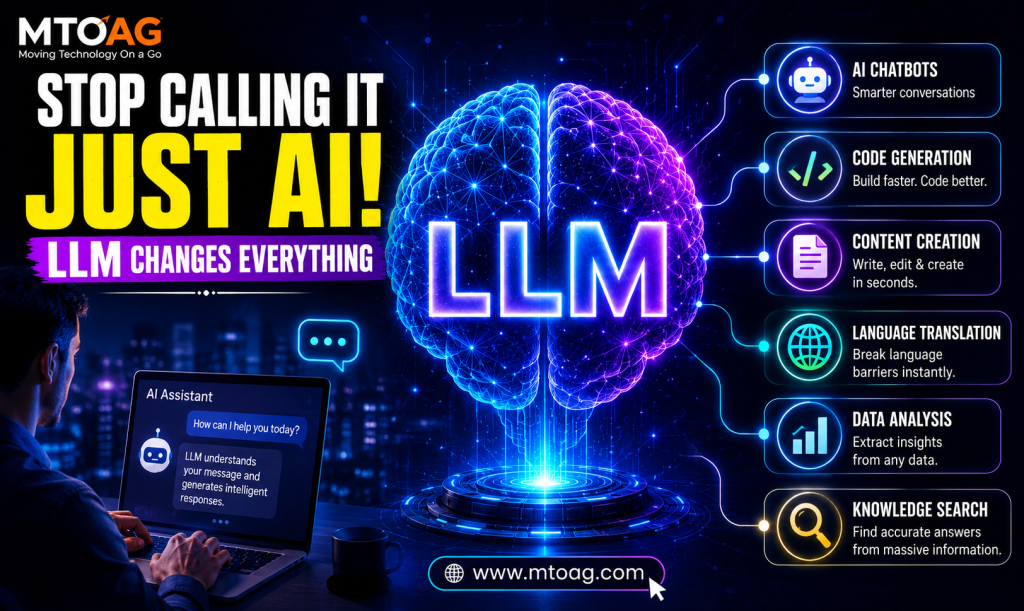
LLMs Power More Than Chatbots
Many people associate LLMs with conversational AI.
That represents only one application.
Today, Large Language Models support numerous technologies, including:
- AI search engines
- Virtual assistants
- Software development tools
- Customer support platforms
- Marketing automation
- Healthcare documentation
- Legal research
- Financial reporting
- Educational applications
As these capabilities continue expanding, businesses increasingly rely on LLMs to improve productivity and automate knowledge-intensive work.
How Businesses Are Using LLM Technology?
Organizations are integrating Large Language Models into daily operations because they reduce manual work while improving efficiency.
Common business applications include:
- Intelligent customer service
- Automated report creation
- Knowledge management
- Email drafting
- Meeting summaries
- Content generation
- Software development assistance
- Internal AI assistants
According to the IBM Global AI Adoption Index, businesses are increasingly adopting generative AI technologies to streamline operations and improve employee productivity.
LLMs Continue Learning Through Better Training
Large Language Models do not memorize individual answers.
Instead, they learn statistical relationships between words and phrases during training.
The training process allows LLMs to:
- Understand context
- Recognize intent
- Predict appropriate responses
- Generate natural language
- Handle multilingual communication
This ability to understand context makes LLMs far more versatile than earlier AI systems.
Benefits of Large Language Models
The popularity of LLM technology continues growing because it offers measurable business value.
Key benefits include:
- Faster content creation
- Improved productivity
- Better customer experiences
- Reduced operational costs
- Smarter knowledge management
- More efficient software development
- Improved multilingual communication
- Scalable automation
Organizations use these capabilities to accelerate digital transformation while improving operational efficiency.
Challenges That Still Exist
Despite their capabilities, Large Language Models are not perfect.
Businesses should understand several important limitations.
These include:
- AI hallucinations
- Outdated information without live data access
- Data privacy considerations
- High infrastructure costs
- Regulatory compliance
- Human review requirements
Successful AI implementation combines LLM technology with proper governance, monitoring, and human oversight.
Why Will LLMs Shape the Future of AI?
Artificial intelligence continues evolving rapidly.
Future Large Language Models are expected to deliver:
- Better reasoning
- Higher factual accuracy
- Stronger personalization
- Improved multilingual capabilities
- Better enterprise security
- More industry-specific AI solutions
As these improvements continue, LLMs will become a core technology behind digital products, enterprise software, and intelligent business automation.
Conclusion
Understanding why LLM means more than just artificial intelligence provides valuable insight into the future of technology. Large Language Models are no longer limited to generating text—they are helping businesses automate operations, improve customer experiences, accelerate software development, and make better use of organizational knowledge. Their ability to understand language and context has made them one of the most influential technologies in modern AI.
Organizations planning to build intelligent AI products often work with experienced LLM development and AI solution providers to create secure, scalable, and business-focused applications. As AI adoption continues to grow, businesses that invest in Large Language Models today will be better positioned to innovate, improve efficiency, and remain competitive in the years ahead.
FAQs
What does LLM mean in artificial intelligence?
LLM stands for Large Language Model, an AI model trained on massive datasets to understand, process, and generate human language.
Why does LLM mean more than traditional AI?
Unlike traditional AI systems that perform specific tasks, LLMs understand language context and can complete many different tasks using the same underlying model.
What industries use Large Language Models?
LLMs are widely used in healthcare, finance, education, legal services, software development, customer support, marketing, and enterprise automation.
Are LLMs only used for chatbots?
No. Chatbots are just one application. LLMs also power search engines, coding assistants, document analysis, translation tools, research platforms, and business automation systems.
Why are businesses investing in LLM technology?
Businesses adopt LLMs to automate repetitive work, improve customer service, accelerate content creation, enhance productivity, and support intelligent decision-making.