

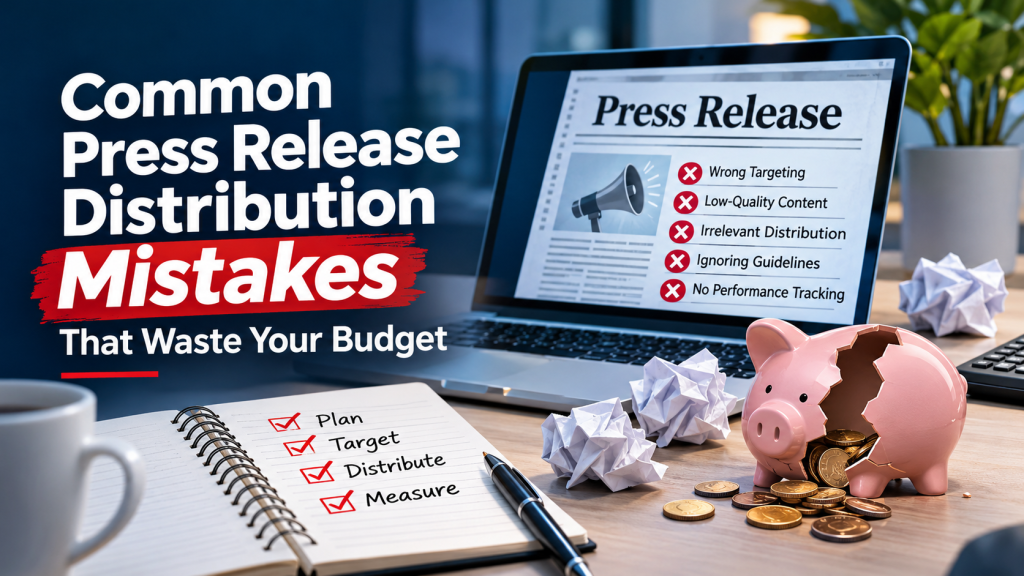
Press releases remain an important communication tool for businesses looking to share company announcements, product updates, executive appointments, research findings, and other newsworthy developments. However, distributing a press release does not automatically guarantee media coverage, audience engagement, or meaningful business results.
Many companies in the United States invest in press release distributions without fully understanding how the process works. Some focus entirely on the number of websites receiving their announcements, while others choose distribution packages based on price rather than relevance. These decisions can lead to unnecessary expenses and disappointing outcomes.
The effectiveness of a press release campaign depends on several factors, including newsworthiness, audience targeting, editorial quality, distribution channels, timing, and performance measurement.
Understanding common distribution mistakes can help businesses make better decisions, use their communication budgets responsibly, and develop more effective media outreach strategies.
1. Choosing a Distribution Service Based Only on Price
One of the most common mistakes businesses make is selecting a press release distribution provider simply because it offers the lowest price.
Although budget considerations are important, the cheapest option is not necessarily the most appropriate. Different distribution services provide different levels of access, geographic coverage, industry targeting, editorial support, and reporting.
For example, a small business announcing a new location may benefit more from regional media distribution than from an expensive nationwide campaign. Similarly, a technology company introducing an enterprise software solution may need access to publications covering business technology rather than a general distribution network.
Before selecting a provider, businesses should examine:
- Geographic coverage and distribution locations.
- Industry-specific targeting options.
- Editorial review and formatting requirements.
- Publication and syndication arrangements.
- Reporting and performance measurement.
- Additional fees and service limitations.
A transparent comparison helps companies understand what they are actually paying for instead of relying exclusively on advertised package prices.
2. Distributing News That Is Not Newsworthy
Another significant mistake is treating every company update as a press release opportunity.
Not every business activity deserves a formal announcement. Routine website updates, ordinary promotional offers, minor internal changes, and repetitive marketing messages may not provide sufficient editorial value for journalists or readers.
A press release should communicate information that is relevant to an identifiable audience.
Examples of potentially newsworthy announcements include:
- Launching a new product or service.
- Announcing a significant business partnership.
- Reporting company expansion into a new market.
- Sharing important research findings.
- Appointing a senior executive.
- Announcing a major funding round.
- Publishing measurable business milestones.
Before investing in distribution, businesses should consider whether the announcement contains information that people outside the organization would genuinely find useful.
A simple question can help: Would someone who is not connected to this company have a reason to read this announcement?
If the answer is unclear, the announcement may need additional context, stronger supporting information, or a different communication format.
3. Ignoring the Target Audience
Press release distribution becomes less effective when businesses attempt to reach everyone instead of identifying the audiences that matter most.
A company operating in the healthcare technology sector, for example, may have little reason to prioritize publications focused on entertainment or general lifestyle topics.
Likewise, a financial technology startup may receive more relevant attention from business, finance, and technology publications.
Audience targeting should begin before the distribution process.
Businesses should identify:
- Industry: Which sector is most closely connected to the announcement?
- Geography: Is the news relevant to a local, regional, national, or international audience?
- Reader interests: What type of information would the intended readers find useful?
- Media preferences: Which publications regularly cover similar developments?
- Communication objectives: Is the announcement intended to inform customers, investors, industry professionals, or business partners?
For organizations targeting the United States, geographic targeting can be particularly important. A local business announcement may be more relevant to regional newspapers and community publications, while a national industry development may justify broader distribution.
The objective should be relevance rather than maximum distribution volume.
4. Focusing on Publication Quantity Instead of Quality
A long list of publication names can make a distribution package appear attractive. However, the number of websites associated with a campaign does not necessarily indicate its effectiveness.
Some distribution networks syndicate the same announcement across multiple websites. Others provide access to industry-specific publications or established media platforms.
These arrangements should not be treated as equivalent.
Businesses should understand the difference between original editorial coverage, press release syndication, and publication through a distribution partner.
Original editorial coverage generally involves independent reporting and editorial judgment. Syndication involves distributing the same announcement through multiple publishing partners. A published press release does not necessarily mean that a journalist independently covered the story.
Before choosing a distribution package, companies should investigate:
- Whether the named publications actually receive the announcement.
- Whether publication is guaranteed or subject to editorial approval.
- Whether the content appears as a syndicated release or an independent article.
- Whether publication links are publicly accessible.
- Whether the provider supplies a verifiable distribution report.
Evaluating these details provides a more realistic understanding of the service being purchased.
5. Publishing Poorly Written Press Releases
Even a well-targeted distribution campaign can underperform when the announcement is poorly written.
Journalists, editors, and business readers expect press releases to communicate important information clearly. Excessive promotional language, unsupported claims, grammatical mistakes, and unnecessary background information can reduce readability.
A professional press release generally includes:
- A clear and informative headline.
- A concise introductory paragraph.
- The announcement’s most important details.
- Relevant supporting facts and figures.
- A meaningful company background section.
- Accurate contact information.
The headline deserves particular attention because it establishes the subject of the announcement. Instead of using exaggerated descriptions, businesses should communicate what actually happened.
For example, a headline such as “Technology Company Introduces New Cloud-Based Platform for Small Businesses” provides more useful information than a vague headline claiming to introduce a revolutionary business solution.
Accuracy is equally important. Every statistic, quotation, product description, and business claim should be reviewed before publication.
Companies can also benefit from having someone unfamiliar with the announcement read the draft. If that person cannot understand the main development quickly, the content may need further editing.
6. Ignoring Publication Guidelines
Different media organizations and distribution platforms maintain their own editorial and technical requirements.
These guidelines may cover article length, headline formatting, hyperlinks, images, financial disclosures, restricted language, industry-specific claims, and acceptable content categories.
Submitting the same press release to every platform without reviewing its requirements can result in delays, revisions, or rejection.
For example, a publication may restrict excessive commercial links, while another may require a specific disclosure for financial announcements. Healthcare-related content may require additional attention to scientific accuracy and regulatory considerations.
Businesses should review the submission guidelines of their selected distribution channels before preparing the final version.
This step can reduce unnecessary revisions and help ensure that announcements meet the expectations of individual platforms.
7. Distributing Press Releases at the Wrong Time
Timing can influence how relevant an announcement appears to its intended audience.
Some companies distribute press releases without considering industry events, major holidays, competing announcements, or the availability of their target audience.
For example, an announcement related to a major technology conference may receive more relevant attention when distributed close to the event. A local business announcement may benefit from timing that aligns with community developments.
However, there is no universal publication day or hour that guarantees media coverage.
The appropriate timing depends on the announcement, industry, audience, and distribution strategy.
Businesses should consider the following factors:
- Relevant industry events and conferences.
- Seasonal business activity.
- Major national holidays.
- Time zones across the intended distribution area.
- Publication deadlines and editorial schedules.
- Whether the announcement is time-sensitive.
Planning distribution in advance can help organizations avoid preventable timing problems.
8. Using Too Many Promotional Links
Links can provide useful context in a press release, allowing readers to access additional information about a company, product, research report, or announcement.
However, including too many promotional links can make an otherwise informative announcement appear like an advertisement.
A press release should prioritize the news itself rather than repeatedly directing readers toward commercial pages.
Businesses should use hyperlinks selectively and ensure that each one adds meaningful context.
For instance, an announcement about a new software platform might include one link to the relevant product information page. A research-related announcement could link to the original study or supporting documentation.
Organizations such as SP Tech Solutions, which work in areas including press release writing and distribution, are part of a broader industry where understanding editorial requirements and contextual linking is important.
The purpose of a contextual link should be to help readers understand the subject more thoroughly, not simply to increase the number of promotional references.
9. Failing to Verify Distribution Reports
A distribution report is an important part of evaluating a press release campaign.
Unfortunately, some businesses accept basic delivery confirmations without examining what actually happened after submission.
A successful submission does not necessarily mean that an announcement appeared on every publication included in the package.
Companies should request reporting that clearly distinguishes between distribution activity and confirmed publication results.
A useful report may include:
- Confirmed publication URLs.
- Publication names and dates.
- Distribution delivery information.
- Available audience or reach estimates.
- Geographic distribution details.
- Publication status, including pending or rejected submissions.
Businesses should also verify a sample of the reported URLs manually.
This helps identify broken links, duplicate listings, unavailable pages, or discrepancies between promised and delivered services.
It is important to remember that estimated reach, website traffic, impressions, and actual readership are different measurements. They should not be presented as interchangeable indicators of campaign performance.
10. Expecting Immediate Sales and Guaranteed SEO Results
One of the biggest misconceptions about press release distribution is that publishing an announcement automatically generates sales, website traffic, or improved search rankings.
Press releases are primarily communication tools. Their outcomes depend on the quality of the announcement, audience interest, publication exposure, and broader marketing activities.
A distributed announcement may increase the availability of company information online, but this does not guarantee that readers will visit the website or become customers.
Similarly, a backlink appearing within a syndicated press release does not automatically produce a measurable improvement in search engine rankings.
Google evaluates links and content through multiple systems, and links created primarily to manipulate search rankings may fall under its link spam policies.
Businesses should therefore avoid evaluating press release campaigns exclusively through backlink counts or immediate sales.
More meaningful evaluation may include:
- Relevant media coverage.
- Referral traffic from publication websites.
- Engagement with the announcement.
- Brand-related search activity.
- Qualified inquiries associated with the campaign.
- Industry visibility and audience awareness.
These indicators provide a more balanced picture of communication performance.
11. Not Having a Clear Distribution Objective
A press release campaign becomes difficult to evaluate when the business has not defined what it wants to accomplish.
Some organizations distribute announcements simply because competitors are doing so. Others purchase large packages without identifying the audiences or outcomes they expect.
A more structured approach begins with a specific communication objective.
For example:
A startup announcing a funding round may want to communicate its development to investors, industry professionals, and potential partners.
A manufacturing company entering a new US market may want to inform regional business communities and relevant industry publications.
A software company launching a new platform may want to reach technology professionals and businesses interested in the product category.
Each objective requires a different distribution approach.
Before committing a budget, businesses should define the announcement’s purpose, intended audience, relevant media categories, expected deliverables, and measurement criteria.
This makes it easier to determine whether a distribution package is appropriate.
12. Failing to Review Previous Campaign Performance
Another mistake is repeating the same distribution strategy without examining the results of earlier campaigns.
Businesses sometimes purchase similar packages repeatedly, even when previous announcements produced limited relevant coverage or audience engagement.
A post-campaign review can reveal which distribution channels were useful and which provided little value.
For example, a company may discover that regional business publications generated more relevant referral traffic than a broad collection of unrelated websites.
Another organization may find that its industry-specific announcements received stronger engagement than general corporate updates.
These observations can guide future decisions.
A basic campaign evaluation should compare the original objectives with confirmed distribution results, publication quality, available traffic information, and audience engagement.
It is also useful to document unsuccessful approaches. Understanding why a particular campaign did not perform as expected can prevent the same budget allocation mistakes from happening again.
How Businesses Can Build a More Effective Press Release Distribution Strategy
Avoiding common mistakes does not require an unnecessarily complicated process. Most distribution problems can be reduced through careful preparation, realistic expectations, and informed decision-making.
A practical approach includes five stages.
First, evaluate the announcement. Determine whether the information is genuinely relevant to an external audience.
Second, identify the intended readers. Consider industry, geography, professional interests, and the type of media that regularly covers the subject.
Third, prepare accurate content. Use a clear headline, factual information, meaningful quotations, and supporting details.
Fourth, compare distribution providers. Examine actual deliverables, publication arrangements, editorial requirements, reporting, and total costs.
Finally, measure the results. Review confirmed publication URLs, audience engagement, referral activity, and progress toward the original communication objective.
This process helps businesses make more informed distribution decisions while reducing spending on services that do not match their needs.
Final Thoughts
Press release distribution can support corporate communication, media visibility, and the dissemination of important business information. However, its effectiveness depends on more than selecting a package and submitting an announcement.
Choosing providers based only on price, distributing irrelevant news, ignoring audience targeting, overlooking editorial requirements, and misunderstanding performance reports can all lead to wasted budgets.
For US businesses, a thoughtful distribution strategy should prioritize newsworthiness, publication relevance, accurate reporting, and measurable communication objectives.
Rather than focusing exclusively on how many websites receive an announcement, organizations should consider whether the right audiences can access meaningful information through appropriate channels.
Ultimately, responsible budget allocation and realistic expectations are essential to building a sustainable press release distribution strategy.