

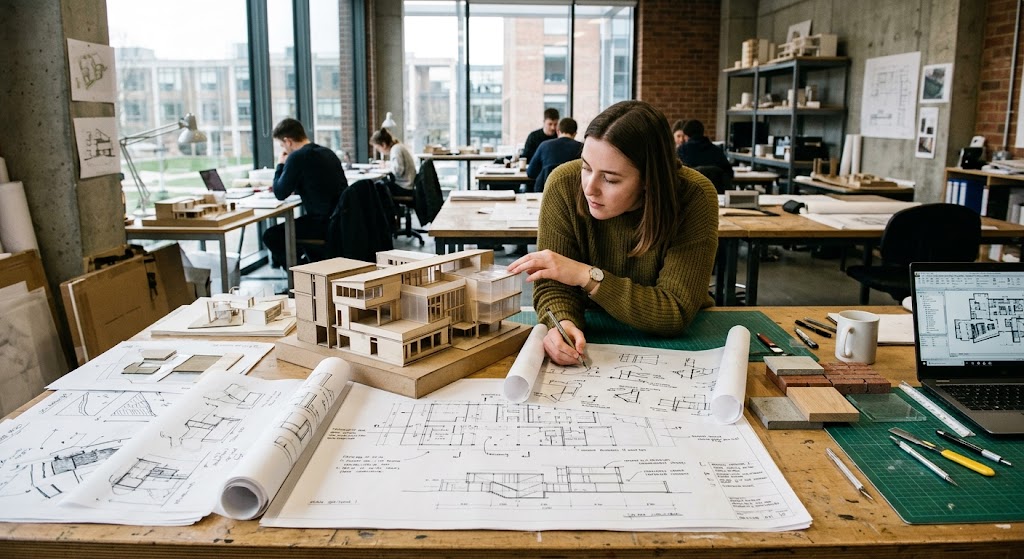
There is a particular moment in an architecture studio when a project looks finished, but somehow does not feel finished.
The renders are clean. The plans are carefully drawn. The model photographs well. Perhaps the presentation board even looks impressive from across the room. Then someone asks a deceptively simple question: “Why did you do it this way?”
Suddenly, the polished image is no longer enough.
That question gets to something many architecture students discover halfway through a project. Designing a building is not simply about arriving at an attractive form. You have to be able to trace the thinking behind it. Why does the entrance sit there? Why does the building turn towards that view? Why is the structure organised in that way? Why these materials rather than others?
Those questions are where a project starts to become architecture rather than just an image of architecture.
When the Design Has to Explain Itself
This becomes particularly noticeable in undergraduate studio work. As projects become more demanding, you are rarely dealing with design in isolation. Site research, spatial planning, environmental conditions, materials, structure and the needs of people using the building begin to overlap.
Imagine a student developing a small community library on a busy urban site. At first, the design might revolve around a strong central idea: perhaps a shared reading space around a courtyard.
That sounds straightforward until the building has to work.
Where does the quieter reading area go? How much traffic can pass through the entrance without disturbing it? What happens to afternoon sunlight? Does the courtyard improve the experience of the building or simply consume valuable floor area? Can the structural arrangement support the spaces being proposed?
The interesting part is that none of these questions necessarily destroys the original concept. They give it something to respond to.
A strong project therefore tends to have a sense of cause and effect. One decision leads somewhere else. The building gradually makes sense because its parts are connected.
Why Some Impressive Projects Still Feel Unconvincing
A common studio problem is having a concept that sounds stronger than it actually is.
“Connected to nature.” “Inspired by movement.” “Creating a dialogue with the surroundings.”
There is nothing inherently wrong with those ideas. The problem begins when they remain descriptions rather than becoming design decisions.
If movement is supposedly central to the project, where can you actually see that idea working? Has the circulation changed? Does the sequence of spaces create compression and release? Has the section developed because of it?
The same thing happens with technical information. A student might add structural diagrams near the end because the presentation needs a technical layer. On paper, the project now appears to contain structure. But if the structure never influenced the earlier design decisions, the drawing can feel strangely detached from the building.
Research can fall into the same trap.
You can have twenty precedent images and still learn very little from them if you have not identified what each one changed in your thinking. A precedent becomes useful when you can say, “I noticed this, tested it here, and it affected this decision.”
That distinction is easy to miss: collecting evidence is not the same as using evidence.
The Hidden Chain Behind an Architectural Decision
One of the most useful ways to look at a project is to follow the chain between an idea, the conditions around it and what happens afterwards.
Take a housing scheme arranged around a shared courtyard. The courtyard is not yet an architectural argument. It is simply an initial move.
Now introduce the actual conditions. The surrounding buildings may restrict daylight. Residents may need different degrees of privacy. The street may be noisy. The courtyard may need to provide somewhere to meet without becoming a circulation shortcut.
Suddenly, one apparently simple decision starts affecting several others.
The position of windows changes. Entrances become more carefully placed. Circulation needs reconsidering. The section may need to respond to daylight. Materials might have to balance privacy with openness.
That is often the moment when you realise, “I hadn’t considered that.”
It is also one of the most useful moments in a design process because it means the project has started pushing back against the original idea.
Architecture becomes much more interesting when your first thought is allowed to encounter something it did not anticipate.
What Should You Actually Look for in Your Own Project?
Rather than asking whether every part of the building is “good”, look at the relationships between its parts.
Does the site analysis affect the plan?
Does the plan create structural consequences?
Does the structure influence the spaces people experience?
Do material choices make sense in relation to construction, atmosphere and context?
Have environmental conditions affected orientation, openings or shading?
These questions are more revealing than simply asking whether a particular drawing looks professional.
The same applies to the way you communicate the project. A perspective might explain atmosphere and scale beautifully, but it cannot necessarily show how a wall is assembled. A section can reveal spatial relationships that disappear completely in a rendered view. A process model might expose a problem that the final model conveniently hides.
This is one reason students sometimes become frustrated when researching best architecture coursework help. The difficult part is rarely finding another attractive presentation example. The more useful question is what makes an architectural project understandable when somebody looks beyond the final image.
Once you start looking at work that way, even a simple sketch can become important if it explains a decision that would otherwise seem arbitrary.
How to Make the Thinking Visible
Try taking five decisions from your current project and tracing them backwards.
Do not choose only the dramatic ones. Pick ordinary decisions: the position of a staircase, the depth of a window, the direction of an entrance, the arrangement of a structural grid or the reason one material appears in one area and not another.
For each one, ask:
What caused this decision?
Then ask:
What changed because of it?
Suppose your building turns away from the main road. Saying that you wanted a more interesting façade does not tell the whole story.
Perhaps the road is noisy, so the turn creates a quieter internal space. That affects circulation. The altered circulation changes where the entrance sits. The new entrance affects the structural grid. The resulting orientation changes the amount of afternoon light entering particular rooms.
Now the turn has a story.
More importantly, the story can be shown.
A small site sketch might explain the original observation. A diagram could show the change in circulation. A plan could demonstrate the consequence. A section might reveal what happened to light or structure.
The portfolio then stops behaving like a collection of finished pictures and starts behaving like evidence of thought.
Where Architecture Students Often Overcomplicate Things
There is a temptation to make a project sound more sophisticated by adding theory, terminology and references.
That can work when the theory genuinely helps you see the project differently. It becomes less convincing when a theoretical idea is attached after the design has already been decided simply because the project needs an academic explanation.
The same applies to precedent studies.
You do not necessarily need more examples. You need to understand the ones you already have.
What did the precedent make you notice? What did you borrow, reject or reinterpret? Did testing the idea expose a problem? Did that problem lead somewhere unexpected?
And do not be afraid of showing rejected ideas.
In a real design process, options disappear all the time. A circulation route might create an awkward junction. A material may look right but perform poorly. A structural arrangement may restrict the spaces you wanted. A courtyard may become too dark.
Showing that something failed is not automatically showing weak design thinking. Sometimes it demonstrates that you actually tested the idea rather than pretending the final solution appeared fully formed.
Why This Matters Beyond the Studio
There is a useful habit hidden underneath all of this: learning to explain a decision without hiding behind the final result.
That matters in university because your drawings, models and written work need to communicate the thinking behind the proposal. It matters even more as architecture becomes a collaborative profession.
In practice, the person looking at your drawing may not be the person who made the original decision.
A structural engineer may need to understand why a grid is arranged in a particular way. A colleague may question a material choice. A client may ask why a space has been organised differently from the obvious solution. Someone reviewing the project later may need to understand what evidence led you there.
You cannot always rely on a beautiful render to answer those questions.
The stronger skill is being able to make the reasoning traceable.
The Difference Between Looking Finished and Being Convincing
A good-looking architecture project can attract attention immediately. A convincing one gives that attention somewhere to go.
You see a form and can understand the site condition that influenced it. You see a plan and can trace the spatial decision behind it. You notice a material and can connect it to construction, context or experience. You look at a section and discover something the render could never have shown.
That is the difference.
It does not mean every design decision has to have an elaborate explanation, nor does it mean a project becomes better simply because it contains more diagrams. Architectural thinking is not about producing evidence for the sake of evidence.
It is about making the important relationships visible.
So the next time you look at your project and wonder whether it is strong enough, resist the urge to judge the final image first.
Ask something more revealing: if the render disappeared, could the rest of the project still explain why the building became this way?
If the answer is yes, you are no longer relying on appearance alone. You are demonstrating a way of thinking that has value far beyond the studio wall.