

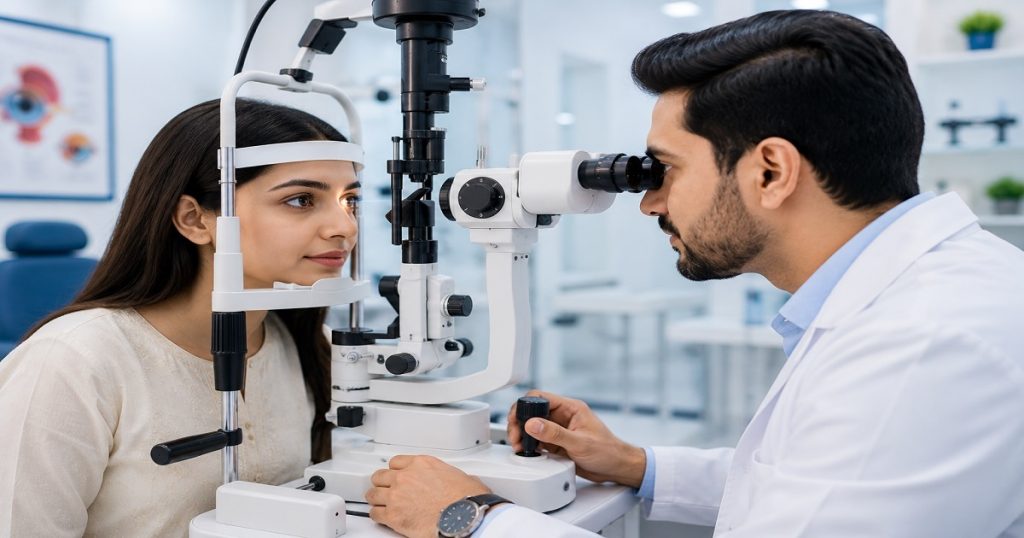
Clear vision is essential for work, education, driving, and everyday activities. Many people in Pakistan rely on glasses or contact lenses to see clearly, but some may consider laser vision correction as an alternative. Understanding what conditions can be treated is an important first step before booking a consultation. Laser Eye Surgery in Lahore may help correct certain refractive errors, including nearsightedness, farsightedness, and astigmatism, in suitable patients.
For people considering Laser Eye Surgery in Lahore in 2027, knowing the difference between treatable vision problems and eye diseases is especially important. LASIK, Femto LASIK, and PRK are designed to correct specific focusing problems, but they do not treat every eye condition. A detailed examination by a qualified eye surgeon is necessary to determine which treatment, if any, is appropriate.
Understanding What Laser Eye Surgery Can Correct
Laser eye surgery is a type of refractive surgery that changes the shape of the cornea, the transparent front surface of the eye. The purpose is to help light focus more accurately on the retina, which can improve vision for people with certain refractive errors.
The most common conditions considered for laser vision correction are myopia, hyperopia, and astigmatism. These conditions affect how the eye focuses light and can make distant objects, close-up text, or objects at different distances appear blurry.
However, laser eye surgery is not a universal treatment for poor eyesight. A person may have blurred vision because of cataracts, glaucoma, retinal disease, or another eye problem. These conditions require different forms of medical assessment and treatment.
How Refractive Errors Affect Vision
A healthy eye focuses incoming light onto the retina. When the shape or length of the eye causes light to focus incorrectly, vision becomes blurred. Glasses and contact lenses correct this problem by changing how light enters the eye.
Refractive surgery changes the cornea itself. This can reduce the need for glasses or contact lenses in people who meet the necessary medical criteria.
The amount of correction possible depends on the patient’s prescription, corneal shape, eye health, and the procedure selected by the surgeon.
Myopia or Nearsightedness
Myopia, also called nearsightedness, is one of the main vision problems that laser eye surgery may help correct. People with myopia can usually see nearby objects more clearly than distant objects.
For example, a person with myopia may be able to read a mobile phone comfortably but struggle to see road signs, classroom boards, or distant faces without glasses.
How Laser Surgery Helps Myopia
In myopia, light focuses in front of the retina rather than directly on it. Laser vision correction reshapes the cornea to help light focus more accurately on the retina.
LASIK, Femto LASIK, and PRK may be considered for suitable patients with myopia. The surgeon determines the appropriate procedure after examining the eyes and reviewing the prescription.
Who May Benefit?
Adults with stable myopia and healthy corneas may be considered for laser vision correction. The prescription must be within the treatment range of the selected procedure, and other eye-health factors must also be suitable.
Patients with changing prescriptions, certain corneal conditions, or other eye problems may not be eligible.
Hyperopia or Farsightedness
Hyperopia, commonly known as farsightedness, is another refractive error that laser eye surgery may help correct in selected patients.
People with hyperopia may experience difficulty focusing on nearby objects. Depending on the severity, they may also have blurred vision at other distances.
Understanding Hyperopia
In hyperopia, the eye focuses light behind the retina when the eye is not accommodating. This can happen because of the eye’s shape or focusing characteristics.
Laser surgery can reshape the cornea to alter how light is focused. However, treatment for hyperopia requires careful assessment because the results and suitability may differ from those for myopia.
Laser Correction for Farsightedness
A qualified refractive surgeon may recommend LASIK or another appropriate procedure for certain patients with hyperopia.
Not every farsighted prescription can be treated successfully with laser surgery. The surgeon will consider the prescription, corneal measurements, age, and overall eye health before making a recommendation.
Astigmatism
Astigmatism is a common refractive error that occurs when the cornea or, less commonly, the lens has an irregular curvature. Instead of focusing light evenly at one point, the eye may focus light in different directions.
This can cause blurry or distorted vision at both near and far distances.
Symptoms of Astigmatism
People with astigmatism may notice that straight lines appear less clear, text looks distorted, or vision remains blurry even when objects are relatively close.
Some patients experience eyestrain, headaches, or difficulty seeing clearly at night. These symptoms can also have other causes, so a proper eye examination is important.
Can Laser Eye Surgery Correct Astigmatism?
Laser eye surgery may correct certain amounts of astigmatism by reshaping the cornea. LASIK and PRK can be options for suitable patients.
The amount and type of astigmatism matter. Corneal mapping and other measurements help the surgeon determine whether laser correction is appropriate.
Mixed Refractive Errors
Some people have a combination of refractive errors. For example, a patient may have myopia with astigmatism or hyperopia with astigmatism.
Laser eye surgery may be able to address certain combinations, depending on the prescription and the patient’s eye health.
Myopia With Astigmatism
A person may have blurry distance vision caused by myopia and additional distortion caused by astigmatism. A suitable laser procedure may correct both problems during the same treatment.
The surgeon must assess whether the corneal shape and thickness support the planned correction.
Hyperopia With Astigmatism
Some patients have farsightedness combined with astigmatism. Treatment may be possible in selected cases, but the surgeon must consider the expected visual results and potential risks.
A detailed consultation helps establish whether the combined prescription falls within the appropriate treatment range.
Presbyopia and Age-Related Near Vision Changes
Presbyopia is an age-related change in the eye’s ability to focus on nearby objects. It commonly becomes noticeable during middle age, when people may need reading glasses for small text.
Why Presbyopia Is Different
Presbyopia is primarily related to changes in the eye’s natural lens and its ability to focus at close distances. Standard LASIK changes the cornea; it does not restore the natural lens’s youthful focusing ability.
This means that ordinary laser eye surgery is not a complete solution for presbyopia.
Can Laser Surgery Help Older Adults?
Some older adults may be candidates for certain forms of refractive surgery, including selected approaches intended to reduce dependence on reading glasses. However, these options involve trade-offs and are not suitable for everyone.
Patients should discuss their near-vision needs, distance-vision goals, and future eye health with an eye surgeon before deciding on treatment.
Conditions Laser Eye Surgery Does Not Treat
Understanding the limits of laser vision correction is just as important as knowing its benefits.
Cataracts
A cataract occurs when the natural lens of the eye becomes cloudy. It can cause blurred vision, glare, and difficulty seeing in low light.
Laser corneal surgery such as LASIK does not remove a cataract. Cataract treatment generally involves surgery to remove the cloudy lens and replace it with an artificial intraocular lens.
Patients with cataracts need an appropriate cataract assessment rather than assuming laser vision correction will solve the problem.
Glaucoma
Glaucoma is a group of eye diseases that can damage the optic nerve, often associated with abnormal eye pressure. It can lead to permanent vision loss if not managed properly.
LASIK does not treat glaucoma or reverse optic nerve damage. Patients with glaucoma or suspected glaucoma require specialist evaluation.
Retinal Diseases
The retina is the light-sensitive tissue at the back of the eye. Conditions affecting the retina can cause blurred vision, flashes, floaters, or other visual changes.
Laser corneal surgery does not treat retinal diseases such as diabetic retinopathy or retinal detachment. These conditions need appropriate retinal assessment and treatment.
Severe Dry Eye Disease
Dry eye disease may cause burning, irritation, fluctuating vision, and discomfort. Significant dry eye symptoms can affect whether a person is suitable for laser surgery.
Patients with dry eyes may need treatment and stabilization before a surgeon can consider refractive surgery. In some cases, surgery may not be recommended.
LASIK, Femto LASIK, and PRK for Vision Correction
Different laser procedures use different techniques to reshape the cornea. The best option depends on the patient’s individual eye measurements and medical needs.
LASIK
LASIK involves creating a thin corneal flap, reshaping the underlying corneal tissue with a laser, and repositioning the flap.
It may be suitable for certain patients with myopia, hyperopia, or astigmatism. Recovery is often relatively quick, but the procedure has potential risks and is not appropriate for everyone.
Femto LASIK
Femto LASIK uses a femtosecond laser to create the corneal flap. It may be considered for patients who are suitable for this technique.
Patients should ask the surgeon why Femto LASIK is recommended and how it compares with other available options for their particular eyes.
PRK
PRK reshapes the cornea without creating a traditional LASIK flap. The surface layer of the cornea is removed or lifted, and the underlying tissue is treated with a laser.
PRK may be considered for some patients who are not suitable for LASIK. Healing is generally slower, and the surgeon will explain the expected recovery process.
How Eye Testing Determines Eligibility
A comprehensive eye examination is essential before laser eye surgery. The surgeon needs to establish whether the vision problem is caused by a correctable refractive error and whether the eyes are healthy enough for treatment.
Prescription Assessment
The surgeon checks the patient’s glasses or contact lens prescription and determines whether it is stable.
A changing prescription may indicate that the eyes are still undergoing changes, making it important to wait before considering surgery.
Corneal Thickness and Shape
Corneal thickness and shape are important because laser surgery removes or reshapes corneal tissue. The surgeon must determine whether the cornea can safely support the planned treatment. Corneal mapping and thickness measurements can help identify certain conditions that may increase the risk of complications.
Eye Health Examination
The examination may include an assessment of the tear film, cornea, lens, retina, and optic nerve. The exact tests depend on the patient’s symptoms and medical history. These checks help identify problems that may require treatment before refractive surgery or make surgery unsuitable.
Preparing for Laser Eye Surgery in Lahore
Patients considering Laser Eye Surgery in Lahore should prepare for their consultation by gathering their current prescription information and details about previous eye treatments. In 2027, patients considering laser vision correction should begin with a comprehensive eye examination and a consultation with a qualified ophthalmologist. Understanding the available procedures, potential benefits, risks, and limitations can help patients make informed decisions about their vision.
Whether you are considering treatment at Zafar Laser Eye Clinic or another eye-care provider in Lahore, professional guidance is essential. A carefully planned approach can help determine whether laser eye surgery is appropriate for your eyes and your long-term vision goals.
Frequently Asked Questions
What vision problems can laser eye surgery correct?
Laser eye surgery may correct certain amounts of myopia, hyperopia, and astigmatism in suitable patients.
Can LASIK treat cataracts?
No. Cataracts affect the natural lens of the eye and require appropriate cataract treatment rather than standard LASIK.
Is astigmatism treatable with laser eye surgery?
Certain types and amounts of astigmatism may be corrected with laser vision correction after a detailed eye examination.
Can older adults undergo laser eye surgery?
Some older adults may be suitable candidates, but age-related near-vision changes and other eye conditions must be considered.
Is laser eye surgery suitable for everyone?
No. Eligibility depends on eye health, prescription stability, corneal measurements, age, and other individual factors.