

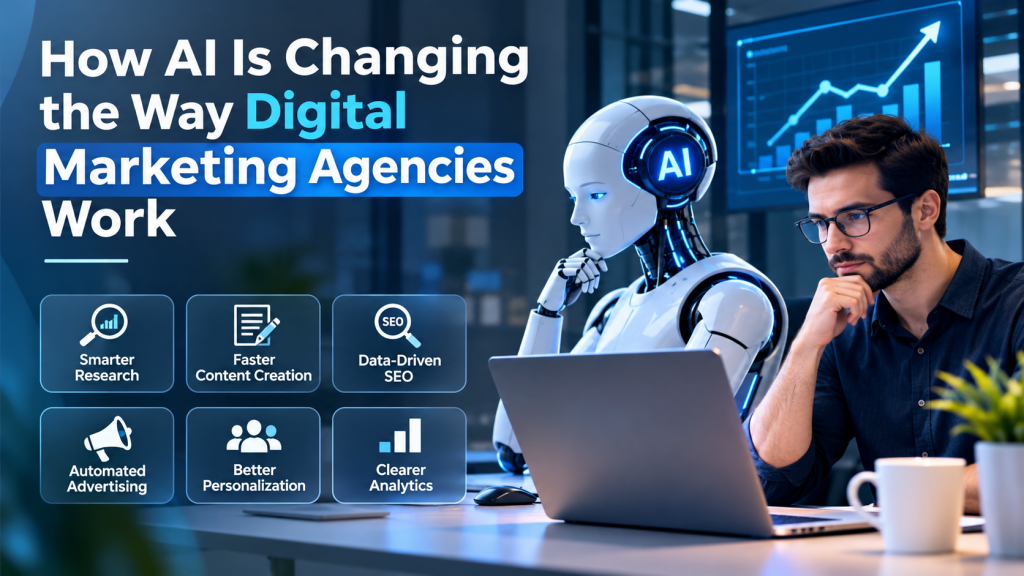
Artificial intelligence (AI) is changing how businesses approach digital marketing Agencies. From analyzing customer behavior to creating content and managing advertising campaigns, AI-powered tools are becoming an important part of everyday marketing operations. Digital marketing agencies are also adapting to these changes by incorporating AI into their strategies, workflows, and decision-making processes.
In the United States, businesses increasingly expect marketing campaigns to deliver measurable results. They want to understand their audiences, improve online visibility, and make better use of their marketing budgets. Traditional marketing methods still have value, but AI is introducing new ways to collect information, automate repetitive tasks, and identify opportunities.
However, AI is not simply replacing traditional marketing activities. Instead, it is changing how marketing professionals work, allowing them to spend more time on planning, creativity, and strategy.
Understanding these changes can help businesses recognize how modern digital marketing agencies operate and what to expect from their services.
1. AI Is Making Marketing Research More Efficient
Market research has traditionally required significant time and effort. Marketing professionals had to review customer surveys, competitor websites, search trends, industry reports, and other sources to understand their target audiences.
AI tools can process large amounts of information much faster. They can identify patterns in customer behavior, highlight popular search topics, and help agencies understand changing market interests.
For example, a digital marketing agency working with a software company can use AI-powered research tools to explore:
- Common problems faced by potential customers.
- Popular search queries related to software products.
- Competitor content strategies.
- Industry trends and emerging topics.
- Customer preferences and buying behavior.
This information can help marketing teams develop more relevant campaigns.
However, AI-generated research should not automatically be treated as accurate. Professionals still need to verify information, review reliable sources, and consider the actual needs of the target audience before making decisions.
2. Content Creation Is Becoming More Organized
Content marketing remains an important part of digital marketing. Businesses use blog articles, website pages, social media posts, email newsletters, and other content formats to communicate with potential customers.
AI has introduced new ways to organize and support content production.
Marketing agencies can use AI tools to generate topic ideas, create content outlines, identify keyword opportunities, and improve existing drafts. These capabilities can reduce the time spent on repetitive tasks.
For example, when preparing a blog about cybersecurity trends, an AI tool may help identify relevant subtopics, suggest questions readers commonly ask, and organize the article into logical sections.
However, publishing AI-generated content without human review can create problems. Such content may include inaccurate information, repetitive explanations, or statements that lack meaningful evidence.
Quality content still requires:
- Original research and reliable information.
- Practical examples and industry knowledge.
- Clear explanations.
- Human editing and fact-checking.
- Relevant information that addresses readers’ questions.
AI can support the writing process, but the final content should reflect genuine expertise and provide value to the audience.
3. Search Engine Optimization Is Becoming More Data-Driven
Search engine optimization (SEO) is another area experiencing significant changes because of artificial intelligence.
Previously, SEO professionals often spent considerable time manually researching keywords, reviewing competitors, analyzing backlinks, and identifying technical website problems.
AI-powered SEO tools can now assist with many of these activities.
For example, agencies can use AI to:
- Identify keyword opportunities.
- Analyze search intent.
- Organize keywords into topic clusters.
- Review website content.
- Identify potential content gaps.
- Analyze technical SEO reports.
- Monitor changes in search performance.
These capabilities make SEO research more efficient and help professionals organize their work.
Search engines are also evolving. Google uses advanced AI systems to understand content, context, and user intent. This means businesses need to focus on producing useful, relevant, and trustworthy information rather than relying entirely on keyword placement.
Google’s guidance on creating helpful, reliable, people-first content provides useful direction for businesses developing SEO strategies.
You can explore its recommendations through Google Search Central’s SEO documentation.
For marketing agencies, the main challenge is balancing technology with human judgment. AI can identify optimization opportunities, but experienced SEO professionals must decide which changes make sense for a particular website and audience.
4. Advertising Campaigns Are Becoming More Automated
Digital advertising requires continuous monitoring and optimization. Businesses running campaigns on Google Ads, Meta Ads, and other platforms need to manage budgets, evaluate performance, and adjust targeting.
AI is helping agencies automate several parts of this process.
Modern advertising platforms use machine learning to analyze performance signals and optimize campaign delivery. These systems can help identify audiences, adjust bidding strategies, and test different advertising approaches.
For example, an agency managing an advertising campaign for an online retailer may use automated bidding to optimize spending based on campaign objectives.
AI can also help marketing professionals analyze:
- Cost per click (CPC).
- Cost per acquisition (CPA).
- Conversion rates.
- Audience engagement.
- Advertising return on investment.
- Creative performance.
Despite these advantages, automation does not guarantee successful campaigns. Poor targeting, unclear messaging, weak landing pages, or unrealistic budgets can still lead to disappointing results.
Human oversight remains important for setting objectives, reviewing performance, and making strategic decisions.
5. Customer Personalization Is Becoming More Advanced
Customers expect businesses to understand their interests and provide relevant experiences.
A generic marketing message may not attract the same attention as content that addresses a specific customer need.
AI allows agencies to analyze customer interactions and identify patterns that can support more personalized marketing.
For instance, an online clothing retailer may use customer browsing history and previous purchases to recommend relevant products. A software company may segment its email subscribers according to their interests and send information about specific product features.
AI can support personalization through:
- Customer segmentation.
- Personalized email recommendations.
- Product suggestions.
- Website content recommendations.
- Behavioral analysis.
- Automated customer communication.
However, personalization must respect customer privacy. Businesses operating in the United States should consider applicable privacy regulations, including the California Consumer Privacy Act (CCPA), as well as relevant state privacy laws.
Agencies must also ensure that customer data is collected, stored, and used responsibly.
6. Social Media Management Is Becoming More Efficient
Social media marketing involves more than publishing posts. Agencies must research audiences, prepare content calendars, monitor engagement, respond to comments, and evaluate campaign performance.
AI tools can simplify many of these responsibilities.
For example, marketing teams can use AI to generate social media content ideas, suggest captions, identify suitable posting formats, and summarize engagement reports.
AI can also help agencies understand which content formats receive stronger audience responses.
Consider a business targeting customers in the United States. Its marketing team may analyze engagement across different regions, age groups, and content categories to understand which topics attract the most attention.
This information can help agencies improve their social media strategies.
Nevertheless, social media communication still requires a human touch. Brand personality, cultural understanding, humor, and customer relationships cannot be managed effectively through automation alone.
7. Marketing Analytics Are Becoming Easier to Understand
Measuring marketing performance is essential for understanding whether campaigns are achieving their objectives.
Agencies typically work with different analytics platforms to monitor website traffic, conversions, customer engagement, and advertising performance.
AI-powered analytics can help organize complex datasets and identify patterns that might otherwise be difficult to notice.
For example, an agency may use AI-assisted reporting to compare website traffic before and after a content campaign. It may also identify pages with declining engagement or campaigns that generate traffic without producing meaningful conversions.
Important marketing performance indicators include:
- Organic website traffic.
- Keyword rankings.
- Lead generation.
- Conversion rates.
- Customer acquisition costs.
- Engagement rates.
- Return on advertising spend.
AI can make these reports easier to interpret, but agencies must understand the context behind the numbers.
A sudden increase in website traffic, for example, does not necessarily mean a campaign has become successful. Professionals need to evaluate traffic quality, user engagement, and business outcomes together.
8. AI Is Changing the Skills Required in Marketing Agencies
As AI becomes more common, digital marketing professionals need to develop new skills.
Knowing how to use an AI tool is useful, but understanding when and how to use it effectively is even more important.
Modern marketing teams increasingly need professionals who understand:
- AI-assisted research and content workflows.
- Search engine optimization.
- Data analysis and interpretation.
- Marketing automation.
- Customer experience.
- Digital advertising.
- Content quality and fact-checking.
- Data privacy and responsible AI usage.
Communication and strategic thinking also remain essential.
An agency may have access to advanced AI software, but without experienced professionals who understand business objectives, the technology may not deliver meaningful results.
This is why many agencies are investing in employee training and updating their internal processes.
9. The Human Role in Digital Marketing Is Still Important
Although AI can automate many activities, it cannot independently understand every business situation or make every strategic decision.
Marketing requires creativity, experience, communication, and an understanding of human behavior.
For example, an AI tool may generate several advertising headlines, but a marketing professional must determine which one accurately represents the brand and connects with its audience.
Similarly, AI may suggest a content strategy based on search trends, but an experienced strategist must consider the company’s reputation, industry requirements, competitors, and long-term objectives.
Businesses and agencies such as sptechsolutions operate in a digital environment where technology and professional expertise can work together to support online marketing activities.
The most effective approach is not to choose between human expertise and artificial intelligence. It is to understand how both can complement each other.
10. Challenges Digital Marketing Agencies Must Consider
Despite its advantages, AI also introduces challenges that agencies should not overlook.
Data accuracy: AI tools can generate incorrect or outdated information. Research and fact-checking are necessary before using their output.
Content originality: Producing large amounts of similar AI-generated content can reduce content quality and fail to meet audience expectations.
Privacy concerns: Customer information must be handled responsibly and in accordance with applicable privacy requirements.
Overdependence on automation: Relying too heavily on AI can reduce human involvement and lead to generic marketing communication.
Changing technology: AI tools and digital platforms continue to evolve. Agencies must regularly evaluate their technology and working methods.
Addressing these challenges requires clear policies, professional oversight, and a focus on long-term marketing objectives.
Conclusion
Artificial intelligence is changing how digital marketing agencies research audiences, develop content, manage advertising, improve SEO, and measure campaign performance.
These technologies offer opportunities to make marketing operations more efficient and data-driven. However, their effectiveness depends on how they are used.
Businesses should not assume that adopting AI automatically leads to better marketing results. Successful campaigns still require clear objectives, accurate information, creative thinking, and an understanding of customer needs.
The future of digital marketing will likely involve a combination of artificial intelligence and human expertise. Agencies that learn to use AI responsibly while maintaining high standards of quality and communication will be better positioned to adapt to the changing digital landscape.
Ultimately, AI is not changing the purpose of marketing. It is changing the tools and processes professionals use to connect businesses with the right audiences.