

Introduction
If you’ve ever watched a kid’s face the first time a throttle answers instantly, you already know why Racing go karts have gone electric. There’s no pull cord, no fumes and no angry neighbours, just torque the moment you ask for it.
At Helmet Karts, the electric lineup covers three very different machines, from a compact sprinter to a modular buggy that tops out at 70 km/h. This is a plain-spoken tour of each one, what the numbers actually mean, and how to pick the right kart for your family or your backyard track.
Why Electric Makes Sense for the Track and the Paddock
Petrol karts are fun, but they come with chores like oil changes, spark plugs, filters and carburettor fiddling. An electric drivetrain skips nearly all of it. You charge the battery, climb in and go. The listings in this range keep returning to the same benefits: instant torque, near-silent running, zero emissions and far less maintenance. If you’re riding near houses, on a rural property or around younger family members, that quiet matters more than most people expect.
Torque is the real headline. Electric motors deliver torque the instant you press the pedal, so a kart feels punchy off the line without screaming about it. These models use brushless motors, which have no brushes to wear out. They’re paired with lithium batteries that hold plenty of energy for their size. So the whole package stays light, responsive and tidy.
F63SE Sprinter: The Smart Way In
The F63SE Sprinter is the entry point, and it’s a clever one. It pairs a 2000W brushless motor with upgraded front and rear suspension and a race bucket seat, and it suits riders between 140 and 185 cm tall. It’s priced at $1,299, down from $1,699. This is the kart you buy when you want real performance without paying for a full-size build.
There are three power modes, which top out at roughly 28, 43 and 58 km/h. Parents will appreciate the built-in speed governor, since you can cap the output for a nervous beginner and open it up as confidence grows. The 10.4Ah lithium battery gives an average range of 8 to 15 km under constant use.
Stopping is handled by mineral hydraulic disc brakes, and the kart carries up to 140 kg. At 130 cm long, it’s compact enough to store easily. You can order it on standard wheels, off-road knobbies or semi slicks, and the advanced version adds 13″ knobbies, a detachable bull bar and an LED halo headlight.
F63XE Sprinter: Bigger, Quieter, Goes Further
Think of the F63XE as the grown-up Sprinter. It’s full-sized and it fixes what owners of the original would grumble about: chain noise, motor adjustments and short ride times. A 1500W QS motor with 2500W peak output drives the rear wheels through a fully enclosed differential, so there’s no exposed chain at all. It sits at $1,599, reduced from $1,699.
The battery is a 48V 20Ah unit, almost double the capacity of the previous model. Expect an average of 12 to 25 km per charge, or roughly 50 minutes to 2.5 hours of constant use. Three power modes cap speed at 30, 45 or 60 km/h. Taller riders get real consideration here. The frame is modular with optional leg extensions, the handlebars are higher and the 19″ wheels lift the ground clearance, so grass, gravel and ruts are easier to handle. It fits riders from 140 to 195 cm and carries up to 160 kg.
Braking is better too. You get dual-caliper hydraulic disc brakes and a parking brake latch, which is handy when the kart’s sitting on a slope. If you want more punch, a controller upgrade is available for $100, and there’s a wheel upgrade option as well.
FA2K: The Modular Buggy That Hits 70 km/h
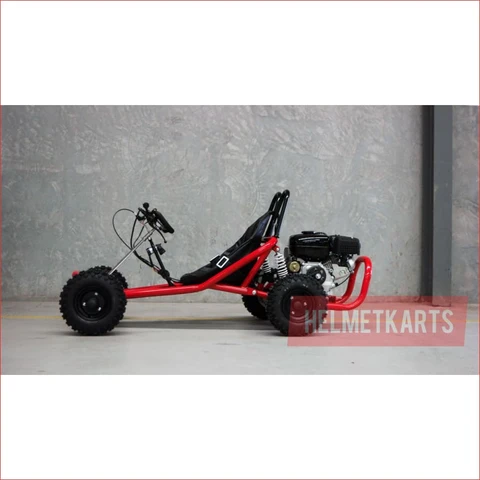
If the Sprinters are the friendly ones, the FA2K is the one that makes grown adults grin. It’s the first electric model in the modular line, so it keeps the customisable chassis that builders love and swaps the petrol engine for a QS motor. That motor is rated at 2000W with a 5 kW peak, and the top speed is 70 km/h. It’s in stock at $2,499, down from $2,799.
A 60V 20Ah lithium battery feeds it, and the control side is properly modern. You get forward and reverse, dual power modes and a digital electric dash. The kart weighs 90 kg, carries up to 140 kg and measures 210 x 110 x 72 cm. It rolls on 16″ steel off-road wheels, with front and rear suspension and hydraulic brakes to keep things composed on rough ground.
Two setups are on offer. The off-road setup uses XXL knobby tyres and a standard bucket seat. The sports setup swaps in semi slick road treads and a low-profile fibreglass bucket seat. Then there’s the fun part: you can ask a specialist to add extras like electric start, front brakes, a roll cage canopy or door nets. It’s built for families, DIY builders and youth groups who like tinkering as much as driving.
Choosing the Right Kart for You
Picking between three good options mostly comes down to who’s driving and where. Height, weight and terrain matter more than raw wattage, and each product page is clear about rider ranges. Start there, then think about how long you’ll be riding in one go and how much you want to customise. Honestly, most people know which kart they want after answering those two questions.
If you’re shopping for a younger or shorter rider, or watching the budget, the F63SE is the sensible pick. The governor and the three power modes let you grow into it. Taller teens and adults who want longer sessions should look at the F63XE, given its 195 cm rider limit, 160 kg load and bigger battery. If you want speed, reverse gear, a digital dash and a chassis you can keep modifying, the FA2K is the one.
A quick note on stock: both Sprinter models are flagged as almost sold out right now, while the FA2K is available. Delivery runs Australia-wide, and if you’re unsure about sizing or extras, the contact page is the quickest route to a real person.
Frequently Asked Questions
How fast do these electric go karts go?
The F63SE offers power modes at roughly 28, 43 and 58 km/h. The F63XE offers 30, 45 and 60 km/h, and the FA2K reaches 70 km/h.
Can kids and adults both ride them?
Yes. The F63SE suits riders from 140 to 185 cm and the F63XE from 140 to 195 cm. The FA2K carries up to 140 kg and is described as suitable for all ages.
How far will one charge take me?
The F63SE averages 8 to 15 km under constant use. The F63XE manages about 12 to 25 km, thanks to its 48V 20Ah battery.
Do they need much maintenance?
Very little. There are no oil changes, spark plugs or filters. The F63XE also drops the exposed chain and the motor adjustments.
Is delivery available?
Yes. All three models list Australia-wide delivery.
Conclusion
Electric karts have stopped being a novelty. They’re quieter, cleaner and simpler to live with, and they still deliver the instant shove that makes driving fun. The F63SE gives newcomers a controlled, affordable start. The F63XE offers a longer-lasting, more refined ride for taller drivers.
The FA2K brings speed, reverse and endless customising to the modular platform. Check the rider heights, match the kart to your terrain, and you’ll end up with something the whole family keeps using.