

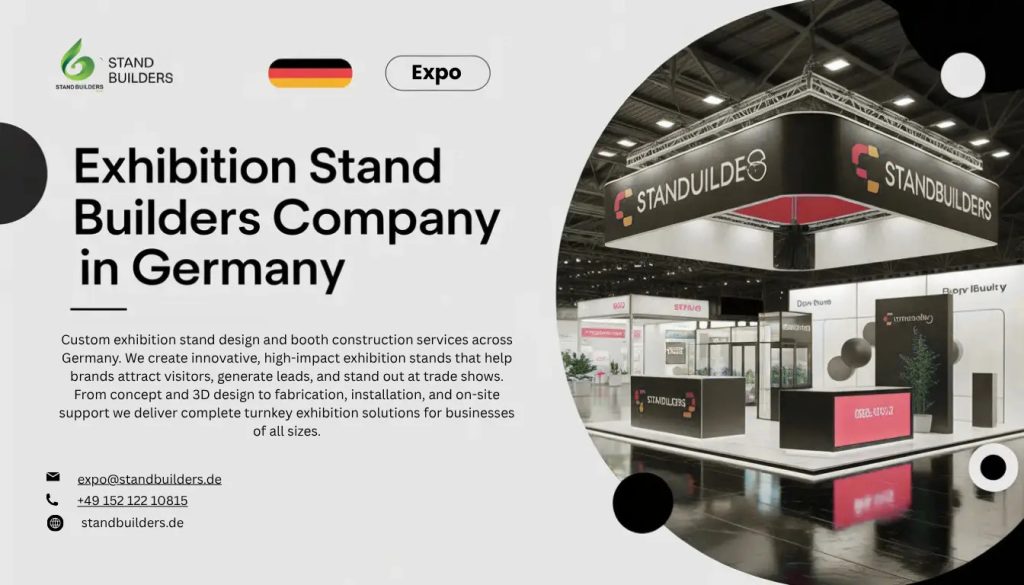
Germany has for a long time been one of Europe’s most important destinations for international trade exhibitions. Major events are held in cities including Frankfurt, Düsseldorf, Munich, Berlin, Cologne and Hannover, the exhibitions covering a wide range of industries such as automotive and engineering as well as healthcare, technology, retail, construction and consumer goods. For companies that are entering these markets, an exhibition is not just a few days devoted to networking; it can instead be a significant chance to launch products, gain an understanding of competitors, meet possible partners and improve their market visibility.
A successful show presence almost never occurs by chance. Whether it’s choosing the right event and setting clear objectives or coming up with an appropriate booth concept, each decision can have an effect on the final outcome. Those who are looking for a company that builds Exhibition Stands Builders in Germany usually find that just as important as understanding the construction of the stand is an understanding of the exhibition environment itself.
Overview of Exhibitions in Germany
Germany has a very developed exhibition sector, thanks to its internationally recognised exhibition venues and specialist trade fairs. Exhibitors and visitors come from all over Europe, Asia, North America and other parts of the world because of the large events.
Frankfurt is famous for hosting major events in the fields of books, automotive technology, consumer goods and financial services; Düsseldorf is especially well known for its medical, packaging, printing, fashion and industrial exhibitions; Munich hosts significant events relating to technology, transport, construction and healthcare, while Hannover is closely linked with industrial technology and manufacturing.
The fact that this is the case means that there cannot be a one-size-fits-all approach to exhibition strategies. For example, a technology company exhibiting at an industrial trade fair will need demonstration areas and technical meeting spaces, while a fashion or lifestyle brand will place more emphasis on visual presentation and product storytelling.
For international exhibitors this difference does matter since the exhibition environment, visitor expectations, the rules of the venue and the target audience all have an effect on the stand concept.
Key Factors to Consider Before Participating
Usually, exhibition planning starts a long way before the stand design phase. The first thing to consider is whether the event that has been chosen actually aligns with the company’s objectives and target audience.
A company might take part in order to generate leads, launch a product, meet distributors, strengthen its existing relationships or merely increase brand awareness; different objectives will require different amounts of space.
Visitor behaviour must also be taken into account. For example, a booth which is mainly intended for product demonstrations will need open circulation space, screens or working displays. One that is focused on confidential negotiations will have to have enclosed meeting rooms. When several objectives are combined, the layout has to strike a balance between openness and functional areas.
Another important point to consider is the venue rules. The limits regarding height, the electrical needs, the use of hanging structures, fire regulations, access times and the installation deadlines can differ from one venue to another. It is advisable to consult the organisers and experienced Stand Builders in Germany early on in order to spot the practical limitations before the design comes to the production stage.
Exhibition Stand Design Approaches
Today’s exhibition stands have long since gone far beyond being just branded counters with printed backdrops. Modern designs usually combine architecture, technology, lighting and storytelling in order to produce a more impressive visitor experience.
Modular Exhibition Stands
Modular systems are especially useful for companies that take part in a number of events since the components can usually be adjusted to fit different booth sizes and locations, which enables businesses to keep their appearance consistent at the same time as keeping their production needs under control.
Custom Exhibition Stands
Built-custom environments offer more freedom when it comes to architectural design, the choice of materials and spatial planning. They are suitable for brands that want to establish a distinctive presence or that need specialised areas for demonstrating products and providing hospitality.
Sustainable Stand Concepts
Sustainability has grown in importance within the German exhibition industry, and the use of reusable structures, recyclable materials, energy-efficient lighting and modular components can help to reduce the amount of waste produced by temporary installations.
Sustainability is therefore not merely an environmental factor for companies that are researching exhibition stand design in Germany; it can also have an effect on transportation, storage, reuse and the long-term costs of exhibiting.
Technology-Integrated Stands
Interactive screens, product configurators, augmented reality experiences and digital presentations can help to engage visitors provided that they are used with purpose. Technology is most effective when it aids in explaining a product or makes the interaction easier rather than becoming a visual distraction.
Understanding Exhibition Stand Costs in Germany
The amount that is allocated to an exhibition can differ a great deal according to the size of the booth, the method of construction, the materials used, the location, the technology, the furniture, the graphics, and the logistics and installation needs.
A fully customised structure usually has different cost consequences than a basic modular one. The use of premium materials, complicated architectural features, hanging signage and built-in technology can lead to higher production and installation costs.
The venue for the exhibition can also affect the cost, since different halls in different cities have different service charges, regulations and logistical requirements, and extra expenses may arise from electricity, internet, storage, cleaning, transportation, dismantling and the rental of furniture.
A good method is to draw up the entire exhibition budget rather than looking only at the cost of construction; a stand which at first seems cheap can end up being a great deal more expensive when you take into account the cost of additional venue services, graphics, transportation and any last-minute changes.
One reason why companies looking at Exhibition Stand Builders Germany should consider the full project scope rather than concentrating on a single quoted figure.
Common Exhibition Mistakes to Avoid
A common error is to start designing a stand without first clearly defining the objective of the exhibition. A booth that is visually striking might still do poorly if visitors are unable to work out what the company has to offer within a few seconds.
A frequently encountered problem is overcrowding. Having too much text, an excess of graphics, large product displays and unnecessary furniture can make it difficult to navigate the booth. When there is a clear visual hierarchy, communication becomes more effective.
Late planning can lead to a different set of problems; when all the design changes, production approvals, shipping arrangements and venue deadlines are not dealt with until the last few weeks, they become hard to manage.
Some exhibitors also fail to take visitor flow into account. The design of a stand should make it easy for people to enter, discover the products, have conversations, and move around. If the layout obstructs the entrance or puts important information in areas that are difficult to see, it will lead to reduced engagement.
In the end, some businesses regard the exhibition as a stand-alone marketing activity; since there is no prior communication, no trained staff is available and there is no follow-up afterwards, a well-designed stand will still yield only limited long-term value.
When Businesses Consider Exhibition Stand Professionals
Businesses do sometimes choose to use an Exhibition Stand Contractor in Germany, especially in cases where the event involves complicated construction, there are strict venue regulations or when there is a large international presence.
Professional involvement becomes useful in cases where a project involves the coordination of design development, the preparation of technical drawings, the selection of materials, fabrication, logistics, and installation as part of a single process. It can also be of assistance to international exhibitors who are not familiar with the local venue procedures.
For any company that is taking part in a number of European exhibitions, working with experienced exhibition stand builders in Europe will give it a more comprehensive knowledge of the regional exhibition requirements. Yet the right amount of professional support will vary according to the complexity of the project and the company’s internal resources as well as its budget.
It doesn’t have to be decided solely on the size of the stand. A smaller booth with complicated technology or regulatory requirements might need more planning than a larger one which has simple modular features.
Conclusion
Giving exhibitions in Germany can offer valuable opportunities for companies operating in both domestic and international markets, but the results rely on far more than simply having a physical booth at the event. A thorough plan, realistic budgeting, suitable design and an understanding of how visitors behave all play a part in creating a more effective exhibition strategy.
When companies are assessing a Exhibition Stand Building Company in Germany, the most sensible thing to do is to look at the entire project and not just focus on the construction aspect. If they understand the design requirements, the rules concerning the venue, the logistics, the sustainability issues and the aims after the event, they will be able to make better-informed decisions and will avoid all unnecessary complications.
In the end, an effective exhibition stand should help achieve the company’s broader marketing goals and at the same time make the visitor’s experience clear, comfortable and relevant. If the project calls for modular construction, a customised environment or technology-driven engagement, thorough preparation is still one of the best bases for a successful exhibition presence.
FAQs
What is the importance of exhibitions in Germany for international businesses?
Germany hosts a large number of internationally renowned trade fairs covering the industrial, technological, healthcare, consumer, and professional fields. This provides companies with the opportunity to meet industry professionals, potential partners, buyers, and their existing customers in concentrated business settings.
What affects the cost of exhibition stands in Germany?
The overall cost can be affected by factors such as stand size, construction type, materials, graphics, furniture, technology, transportation, installation and the provision of venue services together with dismantling. A full project budget gives a more realistic view than the construction costs alone.
What kind of exhibition stand would be appropriate for a company?
The format that should be used will depend on the company’s aims, the amount of space available, its budget and how often it takes part. Modular stands give you flexibility, while custom stands allow for more control regarding the architecture, branding and the visitor experience.
What value does local exhibition knowledge have in Germany?
In Germany exhibition venues have particular requirements regarding technical aspects, safety, installation and services. Having local knowledge enables companies to understand these conditions and to arrange the practical matters more efficiently.
What then should businesses consider when choosing Expo Stand builders in Germany?
It is generally advantageous for businesses to assess a provider’s design capabilities, level of technical understanding, ability to coordinate projects, knowledge of available materials, commitment to sustainability, experience in logistics, and familiarity with the requirements of exhibition venues. The emphasis should be on whether the provider’s capabilities align with the particular requirements of the exhibition project.