

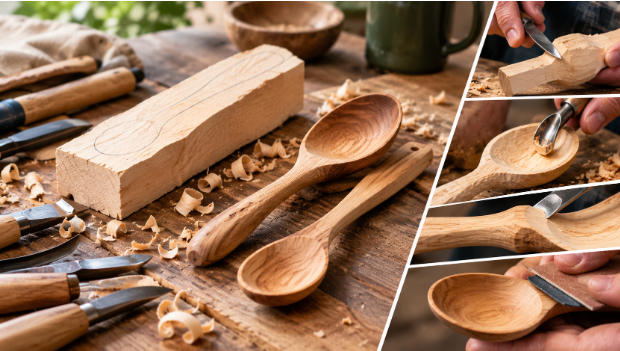
Few woodworking projects offer the same balance of function and craftsmanship as a handmade wooden spoon. Spoon carving combines careful shaping, precise hollowing, and thoughtful attention to grain direction to produce a piece that’s both beautiful and genuinely usable in the kitchen. Whether working entirely by hand or incorporating power tools into the process, makers approach spoon carving as a way to transform a simple wooden blank into a refined, functional object through patience and technique.
Starting with the Rough Blank
Every spoon begins as a rough blank, typically cut roughly to shape before any detailed carving begins. From this point, the carver’s job is to gradually remove material to establish the spoon’s basic form, including the handle, neck, and bowl. This early stage focuses on establishing proportions and overall silhouette, setting the foundation for the more detailed shaping work that follows. Getting these early proportions right makes the later hollowing and refining stages considerably more manageable.
Hollowing the Spoon Bowl
One of the most technically demanding parts of the spoon carving process involves hollowing out the bowl of the spoon, the concave area that gives the piece its function. This step requires careful attention to wall thickness, ensuring the bowl is thin enough to feel balanced in use while remaining strong enough to hold up during regular kitchen use. Achieving a smooth, even curve inside the bowl takes practice, as inconsistent pressure or grain tear-out can create rough spots that require additional cleanup work later in the process.
Working with Grain Direction
Grain direction plays a significant role in how a piece of wood responds to carving. Cutting against the grain often results in tearing or rough surfaces, while working with the grain produces cleaner cuts and a smoother finish. Because a spoon’s bowl and handle often run in different directions relative to the wood’s grain, careful planning is needed to minimize tear-out across the entire piece, particularly in the transition areas where the handle meets the bowl.
Refining Curves and Transitions
Once the basic hollowing is complete, attention shifts to refining curves, smoothing transitions, and adding finishing details like handholds or decorative grooves. This stage is where a spoon moves from a rough functional shape into a piece with genuine visual appeal. Consistent wall thickness and smooth interior surfaces become especially important here, since these details directly affect both the final appearance and how comfortable the spoon feels in use.
Balancing Efficiency with Craftsmanship
Many carvers use a combination of approaches throughout the process, roughing out material more quickly before switching to slower, more controlled methods for fine detail work. This balance allows makers to work through the time-consuming early stages efficiently while still preserving the careful, hands-on control needed for the final refinements. Reducing physical strain during the rougher stages also helps carvers maintain precision and focus when it matters most, during the detailed shaping of the bowl and handle.
Choosing the Right Tools for the Job
Not every carving tool is well suited to the demands of functional woodworking, particularly when shaping food-safe pieces that require clean, predictable surfaces. Tools used for spoon carving need to offer smooth, controlled material removal without tearing the grain or leaving rough, inconsistent surfaces inside the bowl. Compatibility with rotary tools or die grinders also matters for carvers who prefer to combine power carving with traditional hand tools throughout different stages of the project.
Conclusion
Mastering spoon carving takes practice, patience, and an understanding of how wood responds to different cutting techniques throughout each stage of the process. For carvers looking to combine efficient material removal with clean, controlled results, Kutzall offers tools designed to support both the rough shaping and fine detailing stages of functional woodcarving projects.