

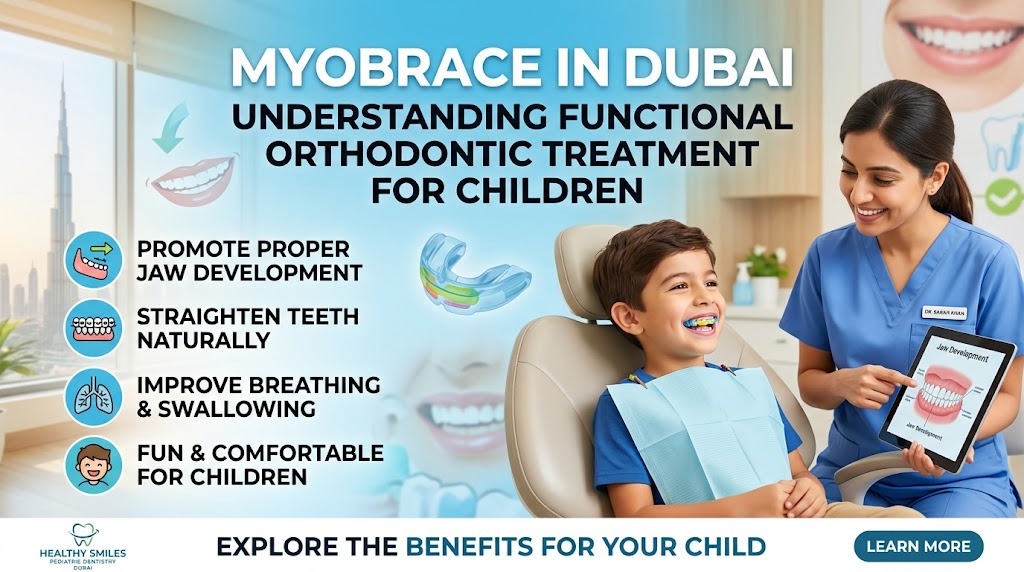
For parents considering orthodontic options for their children, Myobrace in Dubai is an approach that focuses on more than simply moving teeth. The treatment is designed to address oral habits and functional factors that can influence jaw development, breathing, swallowing, and the position of the teeth. It is generally associated with children who are still growing, when certain developmental patterns may be easier to guide.
Unlike conventional braces, which primarily use brackets and wires to reposition teeth, Myobrace treatment uses removable appliances alongside exercises and habit correction. The suitability of this approach depends on a child’s age, dental development, oral habits, and individual orthodontic needs.
What Is Myobrace Treatment?
Myobrace is a type of orthodontic treatment that combines removable dental appliances with myofunctional exercises and behavioural guidance. The underlying idea is that some orthodontic problems can be influenced by the way a child breathes, swallows, rests the tongue, or holds the lips.
Children may develop habits such as prolonged mouth breathing, tongue thrusting, thumb sucking, or incorrect tongue positioning. Depending on the individual, these patterns can affect the development of the jaws and the alignment of the teeth.
A Myobrace appliance is usually worn for a prescribed amount of time each day, often including overnight use. The treatment plan may also involve exercises intended to improve tongue position, lip function, nasal breathing, and swallowing patterns.
It is important to understand that Myobrace is not automatically appropriate for every child with crooked teeth. An orthodontic assessment is necessary to determine whether functional treatment is suitable or whether another approach would provide better results.
Why Parents Consider Myobrace for Kids in Dubai
Interest in Myobrace for kids in Dubai has grown alongside broader awareness of early orthodontic assessment and children’s oral development. Parents often begin looking into treatment when they notice crowded teeth, an open bite, mouth breathing, or other unusual oral habits.
For example, consider a child whose permanent teeth are beginning to appear while the tongue frequently rests low in the mouth and the child regularly breathes through the mouth. An orthodontic professional may look beyond the visible tooth alignment and assess the underlying oral function.
Another situation involves a child with a developing bite problem combined with habits such as tongue thrusting. Simply concentrating on tooth position may not address all the contributing factors. A functional assessment can help determine whether myofunctional therapy has a role in the overall treatment plan.
This does not mean that every child with these characteristics needs Myobrace. Growth patterns vary considerably, and treatment decisions should be based on an individual examination rather than symptoms alone.
How Myobrace Treatment Works
Myobrace treatment in Dubai generally follows a structured process rather than relying on the appliance alone. The first stage is an assessment of the child’s teeth, bite, jaw development, breathing patterns, tongue posture, and oral habits.
If treatment is considered appropriate, the child may receive a removable appliance designed for their stage of dental development. The appliance is used according to the orthodontic provider’s instructions, with regular monitoring to evaluate progress.
Myofunctional exercises can form another part of the programme. These exercises may focus on teaching the child to maintain an appropriate tongue position, develop better lip control, and establish nasal breathing and swallowing patterns.
For younger children, cooperation is particularly important. A treatment programme that requires consistent appliance wear and daily exercises can be difficult if the child does not understand the routine or is unwilling to participate.
Parents therefore have an important practical role. Establishing a consistent routine, keeping the appliance clean, and attending scheduled assessments can make the treatment process easier to manage.
What Problems Can Myobrace Address?
Myobrace is generally associated with developing orthodontic problems where oral function and habits may be relevant. Depending on the individual case, an orthodontist may consider functional treatment when there are concerns involving:
- Developing dental crowding
- Certain bite irregularities
- Tongue thrusting
- Incorrect tongue resting position
- Mouth breathing
- Poor lip seal
- Thumb or finger sucking habits
- Some early-stage jaw development concerns
These conditions can have different causes, so it would be inaccurate to suggest that a single appliance can correct every case.
For instance, a child with mild developing crowding may have a very different treatment plan from a child with a significant skeletal discrepancy. In the latter situation, a specialist may recommend other orthodontic or dental interventions, either instead of or alongside functional therapy.
The child’s stage of growth is another important consideration. Early assessment can provide useful information about how the teeth and jaws are developing, but early treatment does not necessarily mean immediate appliance therapy.
Myobrace vs Traditional Braces
Myobrace and traditional braces approach orthodontic concerns in different ways.
Traditional fixed braces use brackets, wires, and other components to apply controlled forces to teeth. They are commonly used for a wide range of alignment and bite problems, particularly when precise tooth movement is required.
Myobrace appliances are removable and are generally used with functional exercises and habit correction. This makes the treatment concept different from conventional fixed orthodontics.
A practical example is a teenager with significantly rotated permanent teeth. Fixed orthodontic treatment may be considered because precise tooth movement is required. In contrast, a younger child with developing alignment concerns and specific oral habits may be assessed for a functional approach.
The two approaches should not necessarily be viewed as competing treatments. Orthodontic care is highly individual, and some children may require different methods at different stages of development.
Choosing an Appropriate Orthodontic Assessment in Dubai
Parents researching children’s orthodontic treatment in Dubai should look for an assessment that considers the whole oral and facial development rather than focusing exclusively on whether the teeth appear straight.
Questions about breathing, tongue posture, swallowing, oral habits, jaw growth, and dental development can provide useful clinical context. Parents may also want to understand how frequently the child will need monitoring and what level of daily cooperation the treatment requires.
A qualified orthodontic professional can explain whether a child’s particular condition is suitable for functional orthodontic treatment, conventional braces, monitoring, or another intervention.
In Dubai, AQR Orthodontics is one local orthodontic practice where families may encounter discussions around children’s orthodontic assessment and treatment options. As with any dental treatment, the appropriate method depends on the individual patient’s clinical needs rather than the popularity of a particular appliance.
Conclusion
Myobrace in Dubai represents a functional approach to orthodontic care that combines removable appliances with exercises and attention to oral habits. It is particularly relevant to discussions around children’s developing teeth, jaws, tongue posture, breathing, and swallowing.
However, Myobrace is not a universal replacement for conventional orthodontics. Children have different growth patterns and dental conditions, and some may benefit from monitoring or other orthodontic techniques instead. A detailed assessment is therefore essential before deciding whether this type of treatment is appropriate.
For parents, the most useful starting point is understanding that orthodontic development involves more than tooth alignment alone. Looking at growth, oral function, habits, and long-term dental development can provide a more complete picture of a child’s orthodontic needs.