

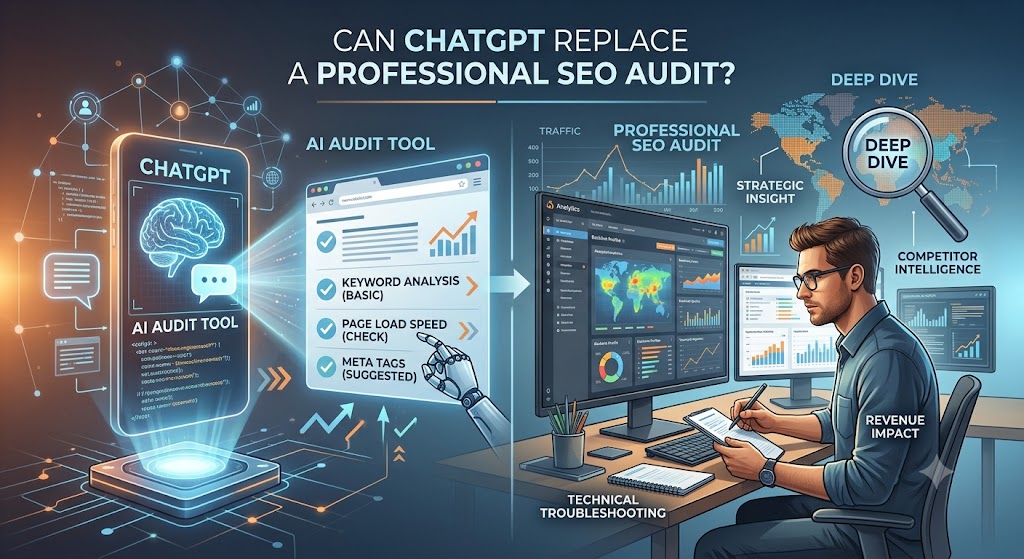
AI has made it much easier for businesses to review website content, understand SEO concepts, and identify potential optimization opportunities. ChatGPT can help analyze information provided by a business and turn that information into practical SEO recommendations. This makes it useful for an initial website review, especially when a business wants to understand what might be affecting its search visibility.
But there is an important distinction between AI-assisted SEO analysis and a complete professional SEO audit.
A professional audit can involve crawling the website, checking technical configurations, analyzing indexing behavior, reviewing performance data, examining backlinks, studying competitors, and investigating how different issues interact. ChatGPT can assist with interpreting many of these findings when the relevant data is available, but it should not automatically be treated as a replacement for the entire audit process.
The better question is therefore not simply whether ChatGPT can audit a website. It is which parts of an SEO audit can ChatGPT handle, and which parts still require dedicated tools, data, and professional analysis?
1. What Can ChatGPT Actually Analyze With a Free Website Audit Tool?
ChatGPT can be useful for reviewing many of the SEO elements that can be provided as text, reports, exports, or other structured information. A business can share page content, title tags, headings, meta descriptions, keyword lists, internal-link information, or audit findings and use ChatGPT to identify potential areas for improvement.
For example, if a business provides the content from an important service page, ChatGPT can examine whether the page clearly addresses its topic, whether the headings are logically organized, whether the content appears repetitive, and whether the page aligns with the intended search query.
It can also help explain technical SEO terminology. A business owner who receives an SEO report containing references to canonical tags, redirects, structured data, crawl errors, or indexing issues can use ChatGPT to understand what those findings mean and why they may matter.
This makes AI particularly useful during the interpretation stage. Triple Minds can also use AI-assisted analysis alongside broader SEO processes to help businesses understand audit findings and organize potential optimization priorities.
Keyword analysis is another useful application. When keyword data is available, ChatGPT can help group related terms, identify similarities between pages, organize keywords according to search intent, and suggest areas where content may need better topical coverage.
However, the quality of the analysis depends heavily on the information provided. ChatGPT cannot make an accurate judgment about a website simply because its domain name is known. The system needs relevant website data, page content, reports, or other accessible information to analyze specific SEO conditions.
This is an important difference between using ChatGPT and running a dedicated audit. A Free Website Audit Tool may collect predefined technical and on-page signals automatically, while ChatGPT can help interpret available findings and turn them into understandable recommendations.
2. Where ChatGPT Can Help With Technical SEO
Technical SEO can be difficult for non-technical website owners to understand, and ChatGPT can be useful for explaining technical problems and suggesting possible solutions.
For example, a business may have a report showing pages that return errors, incorrect redirects, missing canonical tags, indexing issues, or problems with XML sitemaps. ChatGPT can explain what these issues generally mean, discuss their potential impact, and help organize them according to their likely importance.
It can also review technical information that a business exports from SEO platforms or website tools. If the available data shows patterns across URLs, status codes, metadata, or other technical elements, ChatGPT can help summarize those patterns and identify questions that deserve further investigation.
Another useful role is documentation. Developers and marketers often need to understand exactly what an SEO issue means before making changes to the website. ChatGPT can translate technical findings into simpler language and help create implementation notes or checklists.
But there is an important limitation: interpreting technical data is not the same as independently discovering every technical issue.
A professional audit may require direct crawling, server-level information, analytics data, Search Console information, rendering checks, performance testing, and other sources that are not automatically available to ChatGPT. Without those inputs, its analysis may remain incomplete.
ChatGPT should therefore be viewed as a useful layer for understanding and organizing technical SEO information rather than assuming that it has automatically inspected every part of a live website.
3. Where ChatGPT Has Clear Limitations
The biggest limitation appears when businesses expect ChatGPT to perform a complete audit without giving it enough data or access to the systems required for detailed investigation.
SEO is not based only on visible page content. A website can have strong copy and well-written titles while still experiencing problems with crawling, indexing, redirects, site architecture, page performance, canonicalization, structured data, or other technical elements.
External data also matters. Search Console information can reveal impressions, clicks, indexing patterns, and search queries. Analytics data can provide information about traffic and user behavior. Backlink tools can reveal referring domains and potentially problematic link patterns. Competitor research can show how other websites are structuring content and targeting search demand.
Without these inputs, ChatGPT may produce recommendations that are reasonable in general but not necessarily specific to the website being analyzed.
There is also a risk of overconfidence in automated recommendations. An AI-generated suggestion should be checked against the actual website and supporting data before implementation, particularly when a technical change could affect indexing or site performance.
For this reason, ChatGPT is often most useful when it works with SEO data and audit tools, rather than being expected to replace the complete process of collecting and verifying that data.
The distinction becomes increasingly important as websites grow more complex. A small website may only need a basic review of its content and on-page SEO to identify obvious opportunities, while a large e-commerce or multilingual website may require much deeper technical investigation.
4. What a Professional SEO Audit Checks That ChatGPT May Not
A professional SEO audit typically goes beyond reviewing written content and basic recommendations. It involves collecting and examining technical, search, performance, and competitive data to understand how the website is actually performing and where problems may exist.
One major area is crawlability and indexation. An audit can examine whether search engines are able to discover important pages, whether valuable URLs are being excluded from indexing, and whether technical configurations are preventing pages from appearing in search results.
Site architecture is another important area. A large website may have hundreds or thousands of pages, and the relationship between those pages can affect how search engines discover and understand the site’s content. An audit can examine internal linking, navigation structures, orphan pages, URL organization, and the distribution of important pages across the site.
Performance analysis can also require dedicated tools and direct testing. Issues involving page speed, Core Web Vitals, mobile performance, JavaScript rendering, or resource loading may not be visible from the written content alone. These areas require actual measurements rather than assumptions.
A professional audit may also review redirects, status codes, canonicalization, XML sitemaps, robots.txt, structured data, and other technical configurations. These elements can influence how search engines crawl, process, and interpret a website.
Backlink analysis adds another layer. A complete SEO review may examine the website’s referring domains, anchor text patterns, link quality, and broader authority profile. ChatGPT can help interpret exported backlink data, but it cannot independently replace the data collection and specialized analysis involved in a comprehensive backlink review.
Competitor analysis is equally important. A website may appear technically healthy but still struggle to gain visibility because competing pages provide stronger content, better topical coverage, more relevant backlinks, or a more useful user experience.
This is why a professional SEO audit is better understood as a multi-source investigation rather than simply a list of SEO suggestions.
5. ChatGPT vs Professional SEO Audit: What’s the Difference?
The main difference between ChatGPT and a professional SEO audit is not simply that one uses AI and the other uses human expertise. The larger difference is the scope of data collection, verification, interpretation, and implementation planning.
ChatGPT can be highly useful for analyzing information that has already been collected. It can summarize reports, identify patterns in keyword data, review page content, explain SEO issues, suggest improvements, and help organize a large amount of information into a more understandable format.
A professional audit, however, typically begins by collecting the information required to diagnose the website. This can involve crawling the site, connecting analytics and search data, examining technical configurations, reviewing backlink information, studying competitors, and checking performance across important pages.
Human interpretation also matters when several issues interact. For example, a website may have pages that are technically indexable but still receive little organic visibility because of weak search intent alignment, poor internal linking, or insufficient topical coverage. Identifying how these issues relate to one another requires more than finding isolated errors.
Another difference is prioritization. An automated report may contain dozens or even hundreds of findings, but not every issue deserves the same level of attention. A professional analysis can help determine which problems are affecting important pages, which ones are urgent, and which improvements are likely to have greater business value.
Implementation planning is another important distinction. Finding an issue is only the first step. Businesses also need to know what should be changed, how the change should be implemented, whether there are potential risks, and how the results should be measured afterward.
ChatGPT can support many of these activities, particularly when it has access to high-quality website data. But it works best as an analysis and decision-support layer within the broader SEO process.
6. Can ChatGPT Help Find Content and Keyword Problems?
Content analysis is one of the areas where ChatGPT can be particularly useful. When website content and keyword information are available, AI can help identify pages that may need improvement and uncover patterns that are difficult to review manually across a large site.
For example, ChatGPT can compare page topics, headings, keyword targets, and content structure to identify pages that appear too similar. This can help surface potential keyword cannibalization, where multiple pages are targeting closely related search intent.
It can also help identify thin, repetitive, outdated, or poorly structured content. A page may technically contain the target keyword but still provide little useful information for the visitor. Reviewing the page in context can help reveal where the content needs greater depth or clearer organization.
Search intent is another useful area. Given the target keyword and the existing content, ChatGPT can help assess whether a page appears to address the type of information the searcher is looking for. It can also suggest supporting questions or related topics that may strengthen the page.
Content gaps can be identified in a similar way. If a website has several pages around a topic but fails to address important supporting questions, AI can help organize potential subjects for future content.
However, these recommendations are only as reliable as the information being analyzed. ChatGPT should not assume that a content gap exists simply because a topic is not present on one page. Search performance, competitor data, business relevance, and actual search demand should also be considered.
This makes AI particularly effective when used alongside keyword research, Search Console data, competitor analysis, and other SEO sources. The result is a more informed content review that combines automated analysis with real search and business data.
7. Can ChatGPT Help Businesses Prioritize SEO Problems?
An SEO audit can produce a long list of issues, but not every issue deserves immediate attention. One of the useful roles ChatGPT can play is helping businesses organize audit findings and understand how different problems may affect the website.
For example, an audit may identify broken links, missing metadata, slow pages, duplicate content, indexing problems, weak internal linking, and outdated articles. ChatGPT can help group these findings into categories and explain what each issue means, making a large report easier for a business owner or marketing team to understand.
It can also help create a practical priority framework. Problems affecting important pages, search visibility, crawling, or conversions may deserve attention before smaller formatting issues. Similarly, issues that can be fixed quickly may be separated from improvements requiring larger development or content investments.
This can be particularly useful for businesses that receive technical SEO reports but do not have an in-house SEO specialist who can immediately interpret every recommendation.
However, prioritization should not be based only on AI-generated suggestions. The business context matters. An issue affecting a high-value service page may be more important than the same issue on a low-priority blog article. Search performance, traffic, conversions, revenue impact, and implementation difficulty should all be considered.
ChatGPT can therefore help turn a large collection of findings into a more understandable action plan, while the final priorities should be checked against actual website data and business goals.
8. When Is ChatGPT Enough for a Basic SEO Review?
ChatGPT can be useful for an initial SEO review when a business has a relatively small website and wants to understand obvious content or on-page opportunities.
For example, a business can provide page content, title tags, meta descriptions, heading structures, keyword information, or an existing SEO report and ask ChatGPT to identify potential issues. This can help create an initial list of improvements before more detailed work begins.
It can also be useful when a business is trying to understand why an individual page may not be performing well. Reviewing the page’s content, target keyword, search intent, headings, and internal-link structure can provide useful starting points for optimization.
Small businesses may find this approach especially useful for learning the basics of their website’s SEO and identifying areas worth investigating further.
However, “basic review” is the important distinction. ChatGPT is much less likely to provide a complete picture when a website has hundreds or thousands of pages, complicated technical architecture, multiple language versions, significant e-commerce functionality, or major traffic problems.
Businesses should also be careful about treating AI-generated recommendations as verified findings. A suggestion may identify something worth checking, but the underlying website data should confirm whether the issue actually exists and whether a particular change is appropriate.
For a small website with straightforward requirements, ChatGPT can therefore be a useful first layer of analysis. It becomes less suitable as a standalone approach when the website’s technical, content, competitive, or business complexity increases.
9. When Should a Business Get a Professional SEO Audit?
A professional SEO audit becomes more useful when a business needs a detailed explanation of persistent or complex search-performance problems.
A sudden decline in organic traffic is one example. If traffic falls significantly, the cause may involve indexing, technical changes, content performance, search demand, competitors, algorithm changes, or several factors at the same time. Identifying the actual cause usually requires access to multiple data sources and careful investigation.
Website migrations are another important situation. Moving to a new domain, changing URLs, redesigning the site, or restructuring navigation can create technical problems that affect search visibility. A deeper audit can help identify risks before or after the migration.
Large e-commerce websites may also require professional analysis because of their scale. Thousands of product and category pages can create issues involving duplicate URLs, faceted navigation, internal linking, indexing, canonicalization, and crawl efficiency.
Multilingual websites can introduce additional complexity. Businesses operating Arabic and English versions, for example, need to consider language relationships, indexing, content duplication, technical structure, and regional targeting.
A professional audit can also be valuable when a business has already made multiple SEO changes but cannot determine which problems remain. Instead of continuing to make isolated adjustments, a comprehensive review can establish a clearer picture of the website’s current condition.
The decision should ultimately depend on the website’s complexity and the importance of organic search to the business. ChatGPT can support the analysis, but situations involving significant traffic losses, technical complexity, major migrations, or important revenue-generating websites generally justify a deeper and more data-driven audit.
10. How to Use ChatGPT Alongside a Professional SEO Audit
ChatGPT does not have to compete with professional SEO work. It can be used alongside an audit to make the information easier to understand and act upon.
For example, a business can provide an audit report and ask ChatGPT to summarize the findings in plain language. Technical terms can be explained, issues can be grouped by category, and large reports can be turned into more readable action lists.
It can also help analyze exported data. Keyword reports, page inventories, metadata spreadsheets, content lists, or Search Console exports can be examined for patterns. ChatGPT can help organize this information and generate questions that deserve further investigation.
Another useful role is supporting content optimization after the audit. Once professionals identify pages with content weaknesses, ChatGPT can help rewrite sections, improve headings, organize related topics, or develop ideas for supporting articles.
The important distinction is between assistance and verification. ChatGPT can help businesses understand, organize, and act on SEO information, but the underlying data still needs to come from reliable SEO tools and website systems.
A useful workflow can therefore look like this: collect website and search data, perform the technical and SEO analysis, use ChatGPT to interpret and organize the findings, validate recommendations, implement changes, and then monitor the results.
This approach gives businesses the convenience of AI without assuming that a conversational tool automatically replaces the complete audit process.
Conclusion
ChatGPT can be a valuable part of an SEO workflow. It can review content, explain technical findings, organize keyword data, identify potential content issues, and help businesses turn complicated reports into understandable action plans.
At the same time, a complete professional SEO audit involves much more than generating recommendations. It may require website crawling, search and analytics data, technical testing, backlink analysis, competitor research, verification, prioritization, and ongoing measurement.
The most practical approach is therefore to use ChatGPT where it adds efficiency while relying on appropriate tools and professional analysis for data collection, technical investigation, and verification. Triple Minds can help businesses combine detailed website auditing with actionable SEO recommendations, giving teams a clearer understanding of what needs to be fixed and why.
Used together, AI assistance and professional SEO analysis can make the audit process easier to understand while keeping important decisions grounded in actual website and search data.
Frequently Asked Questions
1. Can ChatGPT perform an SEO audit?
ChatGPT can help review website content, keywords, metadata, internal linking, and SEO data provided to it. However, a complete SEO audit may require crawling, technical testing, analytics, Search Console, backlink data, and other specialized information.
2. Can ChatGPT replace a professional SEO audit?
Not in every situation. ChatGPT can support many parts of the analysis, but a comprehensive audit involves data collection, technical investigation, verification, competitor analysis, and business-focused prioritization that may require dedicated tools and professional expertise.
3. What can ChatGPT check for SEO?
It can help analyze page content, titles, headings, meta descriptions, keyword usage, search intent, internal linking, content gaps, and information contained in SEO reports or exported datasets.
4. Can ChatGPT find technical SEO problems?
It can help interpret technical SEO data and explain potential problems such as indexing issues, redirects, canonicalization, sitemap concerns, or crawl errors when that information is provided. It cannot automatically verify every technical condition of a website without the necessary data and tools.
5. Can ChatGPT analyze website content for SEO?
Yes. It can review content for structure, relevance, keyword targeting, search intent, repetition, topical coverage, and potential content gaps. The recommendations should still be checked against actual search data and business goals.