

Customer support is where a brand’s promises meet reality. A customer who gets a fast, accurate answer stays loyal, often for years; one who waits on hold, repeats their problem to three different agents, or never gets a reply quietly leaves and tells others why. The trouble is that support volume keeps growing, customers expect faster answers across more channels than ever, and hiring enough agents to keep pace is expensive and slow. That squeeze, rising expectations against finite human capacity, is the central challenge every support leader faces.
AI-powered customer support solutions exist to relieve that squeeze. Rather than replacing your team, the best systems handle the routine, repetitive questions instantly, route complex issues to the right person, and give agents the context and draft answers they need to resolve tickets faster. The best help desk software for enterprises now blends this AI automation with human expertise, so customers get quick answers to simple questions and thoughtful attention on the hard ones. Used well, it improves both the economics and the experience of support at the same time.
This article explains what AI-powered customer support really involves, why enterprises are adopting it now, and how it transforms the help desk. The examples draw on real deployments, including our own support platform at Atomquark Software LLP, with the trade-offs stated plainly.
What are AI-powered customer support solutions?
AI-powered customer support solutions are help desk and service tools that use artificial intelligence to understand, route, and resolve customer requests, rather than relying solely on manual handling. They interpret natural language, draw on your knowledge base and customer data, and handle common requests automatically, while making human agents faster and better informed on everything else.
A few terms are worth clarifying, since they’re often used loosely.
Help desk software is the core system that captures, tracks, and manages customer requests as tickets across channels like email, chat, and phone. The best help desk software for enterprises adds the scale, integration, security, and reporting that large organizations need. AI-powered customer support is the intelligence layered on top: chatbots and virtual agents that answer directly, smart routing that sends tickets to the right team, and agent-assist tools that draft replies and surface relevant knowledge in real time.
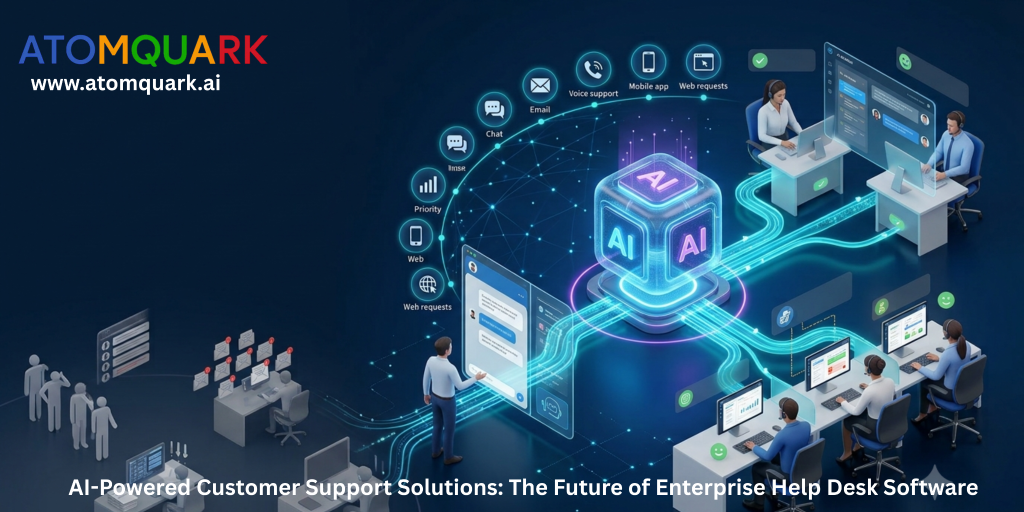
Here’s the practical difference. A traditional help desk logs a ticket and puts it in a queue for an agent to pick up whenever they can. An AI-powered platform reads the incoming request, answers it instantly if it’s a common question, routes it to the right specialist if it isn’t, and hands that specialist a suggested response plus the customer’s full history before they even open the ticket. Same request, dramatically faster and more consistent handling.
Why AI customer support is important for modern enterprises
Support has moved from a cost center to be minimized into a genuine driver of loyalty and revenue, and several pressures are forcing the shift.
The first is customer expectation. People now expect fast, accurate help at any hour, across whatever channel they prefer, because the best digital companies have made that the norm. A slow or clumsy support experience no longer just annoys customers; it actively sends them to competitors and shows up in public reviews. Support quality has become part of the product.
The second is volume and cost. As a business grows, support requests grow with it, and scaling purely by hiring is expensive and hard to sustain, especially with the high turnover common in support roles. Enterprises need a way to handle rising volume without a linear rise in headcount, and automating the routine questions, which are often the majority, is exactly where AI delivers that leverage.
The third is the value of consistency and data. Human-only support is inevitably uneven: answers vary by agent, quality dips when queues are long, and the insight buried in thousands of conversations goes unused. AI brings consistency to common answers and turns support interactions into data about what customers struggle with, feeding product and process improvements. That’s why adoption has accelerated: it addresses cost, experience, and insight at once, which few investments do.
Key benefits of AI-powered customer support solutions
The benefits span cost, experience, and operations. Here they are with the trade-offs attached.
Business automation is the foundation. Routine questions, ticket routing, categorization, and follow-ups run automatically, so a large share of volume is handled without an agent touching it. Improved productivity follows for the team, because agents are freed from repetitive queries and equipped with AI-drafted responses and instant knowledge, letting them resolve complex issues faster.
Cost optimization comes from handling more volume without proportional hiring, plus lower cost per ticket as automation absorbs the routine. Better decision-making follows from the data support generates: patterns in what customers ask reveal product problems, documentation gaps, and training needs that would otherwise stay hidden.
Customer experience is the headline benefit. Faster responses, round-the-clock availability for common questions, and consistent, accurate answers all lift satisfaction, provided the system hands off gracefully to a human when needed. Operational efficiency and scalability come from absorbing spikes and growth without the scramble to hire and train. And security and reliability matter because support systems hold sensitive customer data, demanding strong access controls, encryption, and audit trails.
The honest caveat: AI support done badly is worse than none. A bot that traps customers in loops, refuses to connect them to a person, or gives confidently wrong answers damages trust fast. The benefits depend on designing for smooth escalation to humans and being honest with customers about when they’re talking to AI. The goal is faster help, not a wall between customers and your team.
How AI customer support helps different industries
The core capability is the same; the priorities differ by sector.
Manufacturing and B2B companies handle technical support and warranty or service queries, where AI can triage issues, pull up product and service history, and route complex cases to the right engineer, shortening resolution on complicated problems.
Healthcare uses support tools for appointment queries, administrative questions, and information requests, where speed matters but privacy and accuracy are non-negotiable, so human oversight stays central to anything sensitive.
Retail and e-commerce face enormous volumes of order, returns, and product questions, especially at peak seasons, exactly where AI absorbs routine tickets instantly and keeps service steady when volume spikes.
Logistics and transport field constant status, tracking, and delivery queries, which AI can answer directly from live data, freeing agents for exceptions and complaints that need a human touch.
Finance and professional services handle sensitive, high-stakes queries where AI assists agents with fast information retrieval while humans handle judgment and compliance-sensitive conversations, balancing speed with care.
Across every enterprise, the pattern holds: automate the routine, route the complex intelligently, integrate with customer data, and keep a smooth path to a human for anything the AI shouldn’t handle alone.
Implementation strategies for businesses
This is where support projects succeed or stall, so here’s a practical approach.
Start with planning grounded in your real support data. Look at your actual ticket volume and types: which questions come up most, where customers get stuck, and what’s eating your agents’ time. Automating your highest-volume, most repetitive queries first delivers the fastest return, and capturing your current response times and cost per ticket gives you a baseline to measure against.
On technology adoption, match ambition to reality. Start with AI handling well-understood, common questions and agent-assist for the rest, then expand as it proves reliable. Trying to automate everything at once, including the nuanced cases, is how you end up with frustrated customers and a bot nobody trusts.
Integration is the make-or-break factor. Your help desk has to connect to your CRM, order and billing systems, and knowledge base so both AI and agents have full context on every customer. A help desk cut off from customer data can’t resolve issues well or personalize responses, and customers feel it immediately.
Data management matters because AI support is only as good as the knowledge base behind it. Accurate, well-maintained documentation is what lets AI answer correctly, so investing in your knowledge content is as important as the tool itself.
Security is essential given the customer data involved: role-based access, encryption, and audit logging as standard, with particular care in regulated industries.
Finally, measure ROI against your baseline. Track first-response and resolution times, automated-resolution rate, cost per ticket, agent productivity, and customer satisfaction. Start with a defined use case, prove it improves both experience and cost, then expand.
Future trends worth watching
A few developments are worth planning around.
The clearest shift is toward genuinely capable AI agents. Advances in generative AI mean support systems can now understand and resolve far more nuanced requests than the rigid chatbots of a few years ago, moving from scripted menus toward real conversation. Agent-assist is becoming as important as customer-facing automation, with AI quietly making every human agent faster and more accurate in the background.
Enterprise automation is extending across the whole service lifecycle, connecting support to the systems that actually fix problems, so a request can trigger a resolution rather than just log a ticket. Proactive support is emerging too, where AI spots an issue and reaches out before the customer even complains. One caveat worth keeping in mind: as AI handles more, honest disclosure and solid governance matter more, not less. The winning approach pairs increasingly capable automation with genuine human oversight.
Why choose Atomquark Software LLP
We build support software and run it in production, so this isn’t theory for us.
Our SupportDesk product is a working service platform, not a slide, built to help enterprises manage customer support across channels with automation and intelligence rather than bolted-on chatbots. It sits within a broader suite of proprietary tools, and you can see the full range, including our Warranty Management and TeamTrack products, on our products page. Because we run these systems ourselves, we understand where support automation genuinely helps and where a human still has to step in.
Underneath the products, Atomquark Software LLP is an AI-driven technology company with genuine custom software development in .NET, Python, Java, Spring Boot, and Node.js, plus AI as a Service that embeds SLMs, generative AI, and intelligent automation into real workflows. That engineering depth matters for support, because the hard part is integrating with your CRM and internal systems and tuning AI to your actual knowledge base, and both are serious engineering work.
We back that with technology and operations consulting grounded in PMP-led delivery and Lean Six Sigma, so support improvements target real process problems, and a cyber security practice that builds in Zero Trust access, encryption, and SIEM from day one, which matters because support systems hold sensitive customer data. The proof is in shipped work, including production systems for HMD Global and the Hazen traffic management system in Saudi Arabia, with more on our case studies page. We’re deliberately a partner rather than a vendor; the 80% client retention we hold onto comes from staying involved long after launch.
Frequently asked questions
What are AI-powered customer support solutions?
They’re help desk and service tools that use artificial intelligence to answer questions, route tickets, assist agents, and resolve common issues automatically. They understand natural language, draw on your knowledge base, and handle routine requests instantly, so human agents can focus on the complex cases that genuinely need them.
What is the best help desk software for enterprises?
The best help desk software for enterprises combines omnichannel ticketing, AI-driven automation, deep integration with your CRM and internal systems, strong security and compliance, and reliable performance at scale. Rather than a single universal answer, the right choice depends on your channels, volume, and systems, so evaluate against your actual support workflows.
How does AI improve customer support?
AI answers common questions instantly, routes tickets to the right agent, drafts responses for agents to review, and surfaces the knowledge an agent needs mid-conversation. This cuts response and resolution times, handles routine volume automatically, and lets human agents spend their time on complex, high-value issues.
Will AI replace human customer support agents?
No. AI handles routine, repetitive questions and assists agents, but human judgment and empathy remain essential for complex, sensitive, or high-stakes issues. The most effective approach blends AI automation for scale and speed with skilled agents for the moments that need a human, rather than replacing one with the other.
Can AI help desk software integrate with our CRM and existing tools?
Yes. Strong enterprise help desk software connects to your CRM, order and billing systems, and knowledge base so agents and AI have full context on every customer. Integration is usually the deciding factor in a successful rollout, because a help desk cut off from customer data can’t resolve issues well or personalize responses.
How do enterprises measure the ROI of AI customer support?
Through metrics such as first-response and resolution times, the share of tickets resolved automatically, cost per ticket, agent productivity, and customer satisfaction scores. Capturing these before rollout gives a baseline, so the improvement from AI-powered customer support solutions can be measured rather than assumed.
Customer support no longer has to be a trade-off between speed and cost, or between automation and a human touch. The right AI-powered customer support solutions handle the routine questions instantly, route the complex ones intelligently, and make every agent faster, so customers get quick answers on simple issues and real attention on the hard ones. That’s what the best help desk software for enterprises now delivers: better economics and a better experience at the same time.
If you’re weighing a move, the practical advice is to start from your real ticket data, automate your highest-volume questions first, invest in the knowledge base behind the AI, insist on integration with your CRM and customer systems, and measure resolution times and satisfaction against a baseline you capture before you begin. That’s how AI customer support delivers loyalty and savings rather than frustrated customers stuck talking to a bot.
That’s how we approach it too. Atomquark builds and operates support platforms every day, with as much attention to the human handoff as to the automation. Explore our SupportDesk product to see what we’ve built, or get in touch with our team for a straight conversation about modernizing your customer support. The right first step is usually worth more than any feature list.