

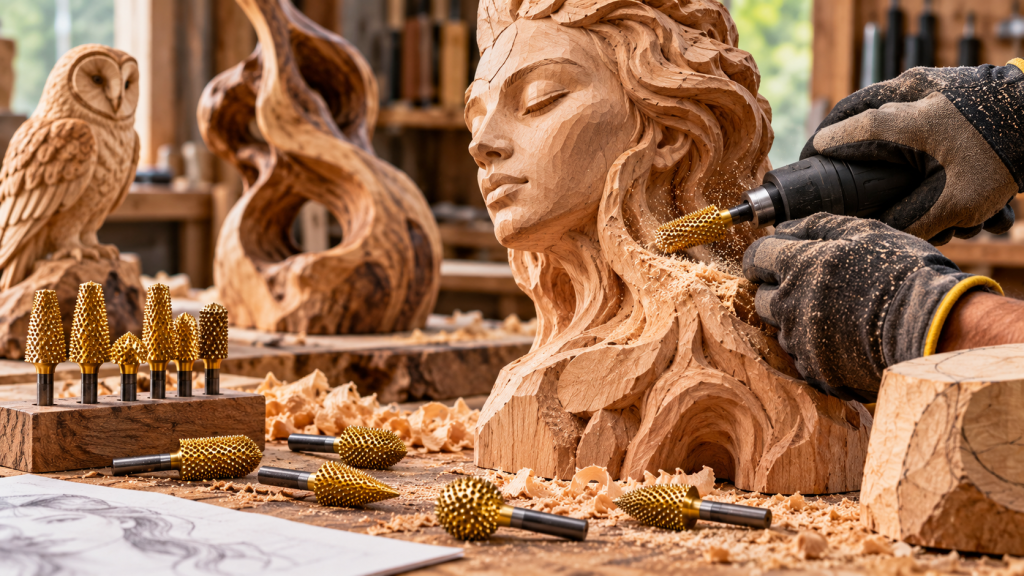
Wood sculpture is built from curves, transitions, and organic surfaces rather than straight lines and right angles. Choosing the right tools for wood sculpture shapes how freely an artist can work and how much control they keep over the final form. Power carving has become a popular approach because it combines the speed of power tools with the freedom of hand carving. It does not replace traditional methods. Instead, it expands what artists can do, from bold abstract forms to fine surface detail. This guide explains where power carving fits in the sculptural process and what to look for when choosing equipment.
Understanding Power Carving for Sculptural Work
Power carving tools work much like rotary chisels. Among the most useful tools for wood sculpture are those that give direct control over grain direction, depth of cut, and the pace of material removal. That control lets artists respond to the wood as the form develops, rather than forcing a fixed plan onto it.
From Rough Blocking to Final Surface
Power carving can be used at nearly every stage of a piece. Early on, aggressive cutters remove large amounts of material quickly to rough out the main form. Later, finer profiles refine curves and proportions, blend transitions between shapes, and develop surface texture.
Depth, Relief, and Undercuts
Because a rotary cutter is easy to guide, artists can create dimensional depth and explore negative space. Undercuts and complex geometry, which can be slow to achieve by hand, become more manageable.
Materials Beyond Wood
The same process works across many materials. Hardwoods, softwoods, laminations, and reclaimed wood are common choices. Many cutters also perform well in foam, epoxy, resin, plastics, and rubber. This flexibility suits mixed-media sculpture that blends carved and fabricated elements in one piece.
How to Choose the Right Carving Tools
Not every carving tool suits sculptural work. When comparing tools for wood sculpture, look for control, versatility, and durability across a wide range of techniques. A good option should cut smoothly without chatter, which keeps the surface clean and the results predictable.
Profiles for Shaping and Detail
Sculpting rarely calls for a single shape. Look for profiles suited to both rough shaping and fine detail, so you can build texture and flowing contours with one set of tools. Controlled stock removal is equally important, since it helps you avoid taking off too much material at once.
Performance and Tool Life
Clean performance on both hardwoods and softwoods matters, but so does longevity. Choose cutters that resist clogging, because loaded teeth cut poorly and slow the work down. Long tool life also reduces how often you need to replace equipment, which keeps costs more predictable over many projects.
Power Tool Compatibility
Check that a cutter works with the equipment you already own, such as rotary tools, die grinders, or flex shafts. Matching the cutter to the power source helps maintain steady speed and control. It also keeps the workflow comfortable during longer carving sessions.
Common Questions From New Carvers
Many beginners ask whether power carving counts as serious sculpture. It does, and many professional sculptors use it as their primary shaping method, especially for large or complex forms. Others ask whether it is only for rough shaping. With the right profiles, it handles both aggressive material removal and delicate surface work.
Some also wonder if it is better than hand carving. It is an expansion rather than a replacement. Faster shaping leaves more time to refine form and finish, which is where much of the artistry happens.
Conclusion
Power carving gives wood sculptors a fast, fluid way to explore shape, depth, and movement while keeping full control over the result. Whether you are roughing out a large form or refining a detailed piece of relief wood carving, the right cutters make each stage smoother and more predictable. Focus on versatile profiles, clean cutting action, durability, and compatibility with your power source. With those basics in place, you can work more freely and spend more time on the creative decisions.