

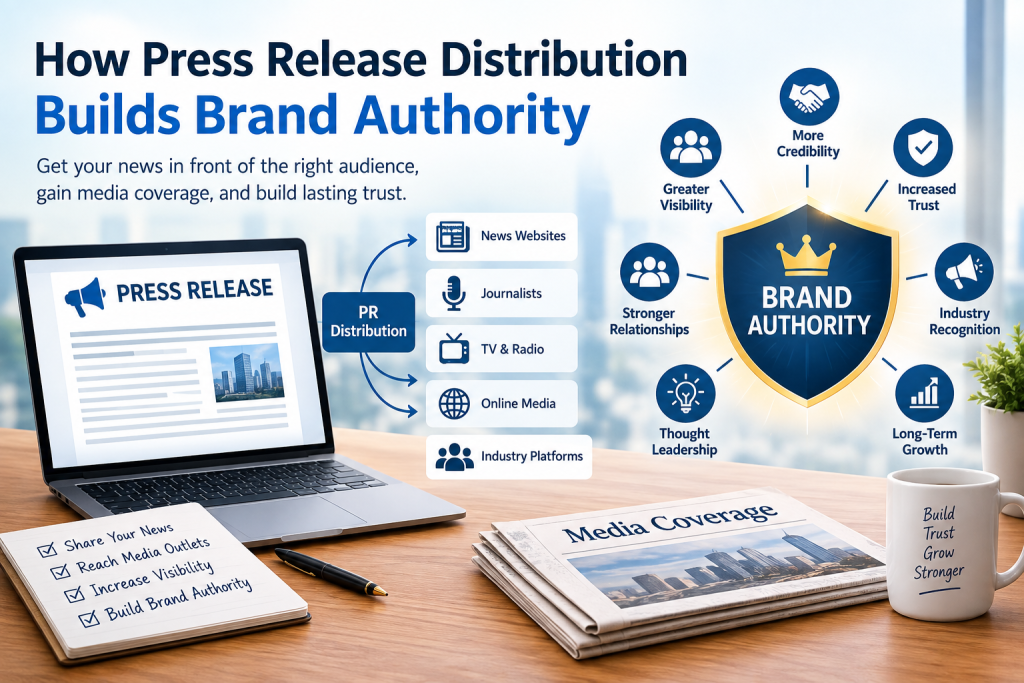
Building brand authority is an important part of long-term business growth. In a crowded market, customers, journalists, investors, and industry professionals often look for signals that a company is credible, active, and knowledgeable. One way businesses can communicate these signals is through strategic PR distribution.
Press release distribution is not simply about sending company news to media outlets. When used appropriately, it can help businesses communicate meaningful developments, establish a consistent public presence, and make important information easier for journalists and audiences to discover.
For U.S. businesses, understanding how press releases contribute to brand authority can help marketing and communications teams develop a more credible and organized approach to public relations.
What Is Brand Authority?
Brand authority refers to the level of trust and recognition a company develops within its industry or market. An authoritative brand is generally associated with expertise, reliability, transparency, and a clear understanding of its audience.
Brand authority is not created by a single advertisement or press release. It develops over time through repeated interactions and credible evidence.
Several factors can contribute to brand authority, including:
- Industry expertise
- Consistent communication
- Media visibility
- Customer experiences
- Thought leadership
- Public recognition
- Transparent business practices
- Relevant company achievements
Press release distribution can support some of these areas by giving businesses a structured way to communicate verified news and developments.
Why Press Releases Matter for Brand Credibility
A press release provides an official way for a company to communicate news. Instead of relying entirely on social media posts or promotional advertisements, organizations can use press releases to present important developments in a more formal format.
Examples of newsworthy announcements may include:
- New products or services
- Business expansions
- Executive appointments
- Partnerships
- Research findings
- Awards and recognition
- Corporate milestones
- Community initiatives
- Industry events
- New locations
The value comes from the information being genuinely newsworthy. A press release should give readers a clear reason to pay attention rather than simply repeat marketing claims.
When a company consistently communicates meaningful developments, audiences may gain a better understanding of what the organization does and how it contributes to its industry.
PR Distribution and Media Visibility
One of the main benefits of PR distribution is that it can make a company’s news available beyond its existing audience.
A business website primarily reaches people who already know about the company or discover it through search engines, advertising, referrals, or other channels. A distributed press release can place company information within a broader news and information ecosystem.
This broader exposure can potentially help a business reach:
- Journalists
- Industry professionals
- Potential customers
- Business partners
- Investors
- Researchers
- Local communities
However, distribution does not guarantee media coverage. Journalists independently decide which stories are relevant to their audiences. Therefore, companies should focus on producing useful, factual, and timely announcements rather than assuming that distribution alone will result in news articles.
Consistency Helps Establish Recognition
Brand authority develops gradually. One announcement rarely changes how an audience perceives a company.
Consistent communication can be more useful because it gives audiences multiple opportunities to understand a business and its activities.
For example, a technology company might publish announcements about a product launch, a research project, a strategic partnership, and participation in an industry event. Individually, each announcement communicates a different development. Collectively, they can create a clearer picture of the company’s role within its market.
This is where PR distribution can become part of a broader communications strategy.
The objective should not be to publish as many releases as possible. Instead, businesses should identify developments that genuinely deserve public attention.
Building Third-Party Recognition
Brand authority becomes stronger when information about a company appears in credible third-party environments.
A company’s own website can explain its expertise and achievements, but independent coverage can provide another layer of visibility. When journalists, industry publications, or other credible sources discuss a company’s activities, audiences can evaluate the information from outside the company’s own marketing channels.
Press releases can contribute to this process by providing journalists with organized background information about a company and its announcement.
For example, a well-prepared release can include:
- A clear headline
- Relevant facts
- Statements from company representatives
- Supporting data
- Background information
- Contact details
- Context explaining why the announcement matters
This makes it easier for interested media professionals to understand the story and determine whether it fits their coverage.
The Role of Evidence in Building Authority
Authority depends heavily on evidence.
A company claiming to be an industry leader does not automatically establish authority. Stronger communication provides specific information that allows readers to understand and evaluate the claim.
Instead of relying on vague statements, businesses can include measurable and verifiable details where appropriate.
For example, a company announcing expansion could provide information about the new location, number of employees affected, investment amount, timeline, or market served—provided these details are accurate and appropriate for publication.
Research-based announcements can also include relevant methodology or data sources.
This approach supports the principles of experience, expertise, authoritativeness, and trustworthiness, commonly referred to as E-E-A-T in online content evaluation.
Expert Quotes Can Add Context
Expert commentary can make a press release more informative.
A quote from a company executive, researcher, technical specialist, or other qualified professional can explain why an announcement matters. The strongest quotes add context rather than simply repeating promotional language.
For example, instead of saying that a new service is “the best solution in the industry,” an executive might explain what problem the service addresses and why the company decided to develop it.
This distinction matters because authority is more closely associated with useful expertise than exaggerated claims.
Companies should also make sure that quoted individuals have the appropriate knowledge or role to discuss the subject.
PR Distribution and Search Visibility
Press releases can also support a company’s broader digital presence.
When company announcements are distributed online, they may create additional opportunities for audiences to encounter the organization and its information. Depending on where a release appears, readers may discover the company through news platforms, industry websites, search results, or other digital channels.
However, businesses should avoid treating press releases as a shortcut for manipulating search rankings.
Search visibility depends on many factors, including content quality, relevance, website structure, technical performance, links, user experience, and the overall credibility of a website.
The primary purpose of a press release should therefore remain public communication. Any search-related benefit should be considered secondary to providing accurate and useful information.
Choosing Newsworthy Topics
Not every company update requires a press release.
A routine internal activity may have little public value. On the other hand, a significant expansion, acquisition, research result, partnership, or community initiative may provide a legitimate reason for an announcement.
Before preparing a release, communication teams can ask:
- Is this information genuinely new?
- Who would find it useful or interesting?
- Does it affect customers, an industry, or a community?
- Can the announcement be supported with facts?
- Is there meaningful context behind the development?
- Is the timing relevant?
These questions help businesses distinguish news from ordinary marketing content.
The Importance of Accurate Information
Accuracy is central to brand authority.
A company may gain short-term attention from exaggerated claims, but inaccurate information can damage trust if readers later discover that the claims were misleading.
Press releases should therefore be reviewed carefully before distribution. Names, dates, statistics, financial figures, quotations, product information, and company descriptions should all be verified.
For organizations operating in regulated industries, additional legal or compliance review may also be appropriate.
Companies should maintain records supporting important factual claims, particularly when announcements involve research, financial information, awards, certifications, or performance statistics.
How Distribution Fits Into a Larger PR Strategy
PR distribution should not operate independently from other communications activities.
A broader public relations strategy may combine press releases with:
- Media relations
- Executive thought leadership
- Industry events
- Interviews
- Company blog content
- Research reports
- Social media communication
- Community engagement
- Customer communications
Each channel serves a different purpose.
A press release can provide the official announcement, while an executive interview can provide deeper analysis. A research report can demonstrate expertise, while an industry event can create direct engagement with professionals.
This integrated approach can help businesses communicate consistently across multiple channels.
Measuring the Impact of PR Distribution
Businesses should measure outcomes instead of assuming that distribution automatically creates authority.
Useful measurements may include:
- Number of media pickups
- Referral traffic
- Relevant audience reach
- Brand mentions
- Journalist inquiries
- Website visits
- Engagement with related content
- Leads or inquiries associated with an announcement
- Growth in branded searches over time
Not every result will be directly attributable to one press release. Brand authority is cumulative, so businesses should evaluate performance across a longer period rather than relying on a single campaign.
For example, an announcement may generate limited immediate traffic but lead to a journalist inquiry that later results in an interview or feature article. Measuring only the initial website visits would miss that broader outcome.
Working With Reliable Distribution Channels
The distribution channel can influence how broadly information is made available.
Businesses evaluating a distribution provider should consider factors such as:
- Geographic reach
- Industry relevance
- Distribution network
- Editorial standards
- Reporting and analytics
- Pricing transparency
- Customer support
- Publication requirements
For companies researching different approaches to PR distribution, resources from organizations such as Vertex Newswire can provide additional context about how press release distribution works and what businesses should consider when planning an announcement.
The most appropriate distribution approach depends on the announcement, target audience, industry, and geographic requirements.
Common Mistakes That Can Weaken Brand Authority
Several mistakes can reduce the credibility of a press release.
Overly Promotional Language
A press release filled with advertising-style claims may be less useful to journalists and readers.
Unsupported Claims
Statements about market leadership, customer satisfaction, performance, or industry position should be supported where possible.
Irrelevant Announcements
Publishing insignificant updates simply to generate content can reduce the perceived value of future announcements.
Poorly Written Quotes
Quotes should provide insight or context rather than repeat the headline.
Excessive Keyword Use
Writing primarily for search engines can make a release unnatural and reduce its usefulness to human readers.
Lack of Verification
Incorrect statistics, names, dates, or product information can create unnecessary reputational problems.
Avoiding these mistakes helps businesses maintain a more professional public communication standard.
Long-Term Authority Requires More Than PR
Press release distribution can support brand authority, but it cannot create credibility by itself.
A strong reputation is built through actual business performance, useful products or services, customer experiences, expert knowledge, transparent communication, and consistent behavior.
PR can help communicate those qualities to a wider audience.
The most effective approach is therefore to treat press releases as one part of a larger reputation-building strategy. When companies have something meaningful to say, a well-researched and accurately distributed announcement can help make that information accessible to journalists, industry professionals, and the public.
Conclusion
PR distribution can contribute to brand authority by increasing the visibility of meaningful company news, creating opportunities for third-party recognition, communicating expertise, and maintaining a consistent public presence.
Its effectiveness depends largely on the quality of the underlying announcement. Businesses should prioritize newsworthiness, factual accuracy, useful context, credible sources, and responsible communication rather than relying on promotional language or unrealistic expectations.
For U.S. businesses, press releases can serve as a practical communications tool when they are integrated with broader media relations, content, and reputation-building efforts. Over time, consistent and evidence-based communication can help audiences better understand a company’s expertise, activities, and position within its industry.