

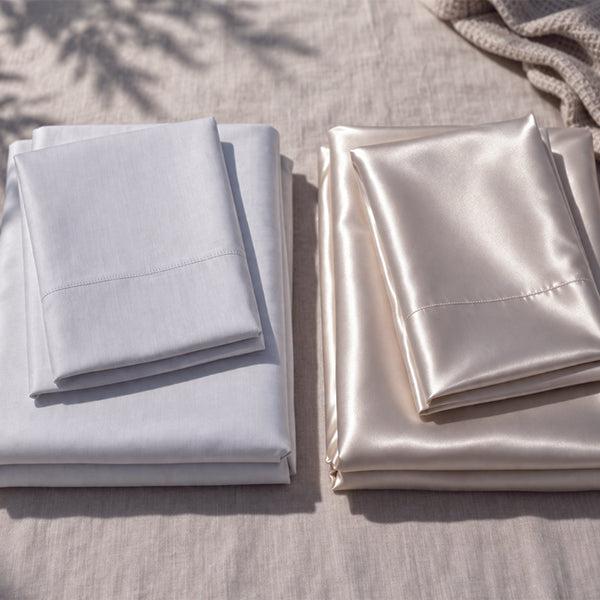
You spend a third of your life in bed. The cotton matters. But so does the weave — and most people never think about it until a bedsheet that looked perfect online feels completely wrong on the actual bed.
Weave is what gives cotton its character. Two bedsheets can be made from identical yarn and feel nothing alike, simply because of how the threads were interlocked. Here is what you actually need to know.
What Is a Weave, and Why Does It Matter?
When cotton is woven into fabric, threads run in two directions — lengthwise (warp) and across (weft). The pattern in which these threads cross over and under each other is the weave. Change the weave, and you change almost everything: how the fabric feels, how it breathes, how it catches light, how it holds up after fifty washes.
The three weave types you will most commonly encounter in bedsheets are plain weave, percale, and sateen.
Plain Weave: The Straightforward One
In a plain weave, each thread passes over one and under one in a simple alternating pattern. It is the most basic construction in fabric-making — and often the most reliable.
The result is a fabric that is even, firm, and matte. No sheen, no texture tricks, just a flat, consistent surface. Plain weave bedsheets tend to be slightly more structured when new and soften gradually with washing.
In India, most handloom cotton bedsheets — including hand-block-printed ones — are made on a plain weave base. The open, balanced structure is exactly what makes handloom cotton breathable and well-suited to warm climates. There is nothing in the weave working against airflow.
Best for: everyday use, warm weather, anyone who prefers a relaxed, matte finish.
Percale: Plain Weave, Taken Up a Level
Percale is a plain weave with a higher thread count — typically 200 and above — and a tighter construction. The difference in feel is immediately noticeable: crisp, cool, and slightly smoother than basic plain weave without crossing into silky territory.
Hotels use percale for a reason. It launders well, holds its shape, and gets more comfortable with every wash. The matte finish means it shows fewer wrinkles than a shiny fabric would.
Percale breathes well, wears well, and does not call attention to itself — which, for something you sleep on every night, is exactly the point. Before your first wash, it is worth knowing that block print bedsheets — whether percale or plain weave — always do better with cold water and a gentle cycle.
Best for: year-round use, people who run warm, anyone who wants a crisp feel over a soft, drapey one.
Sateen Weave: The Shiny One
Sateen uses a different construction — threads float over four or more threads before passing under one. This is what creates the signature sheen. More thread surface sits on top of the fabric, catching light and reflecting it.
The feel is noticeably different from percale. Sateen is softer out of the packaging, heavier, and has a slight drape. The sheen looks luxurious in photographs and in certain bedroom settings.
The trade-off is practical. Because more thread surface is exposed, sateen snags more easily. It also holds heat — the denser structure traps warmth rather than releasing it. For Indian summers, this matters. Sateen might feel indulgent in December, but by April it becomes a problem.
Sateen vs satin: not the same thing. Satin is a weave applied to silk or synthetic fibres. Sateen uses the same structure but on cotton. Similar sheen, completely different material.
Best for: cooler months, decorative use, anyone who prioritises feel and appearance over breathability.
Which Weave Is Right for Indian Homes?
Plain weave and percale are the practical answer for regular use across Indian seasons — particularly where summers are long and humid. The open structure breathes, washes well repeatedly, and stays consistent over time.
This is also why Jaipuri bedsheets have always performed well in Indian conditions — traditionally woven on plain weave handloom cotton, the construction works with the climate rather than against it.
Sateen has its place in winter layering. But as an everyday bedsheet in a warm climate, the weave works against the body more than with it.
The Short Version
| Plain Weave | Percale | Sateen | |
|---|---|---|---|
| Feel | Relaxed, matte | Crisp, cool | Soft, silky |
| Breathability | High | High | Lower |
| Sheen | None | None | Yes |
| Best season | All year | All year | Winter |
| Durability | High | High | Moderate |
Weave is not a selling point most brands highlight — but it is one of the few things that actually determines how a bedsheet feels to live with, night after night. Know the weave, and you know what you are buying.