

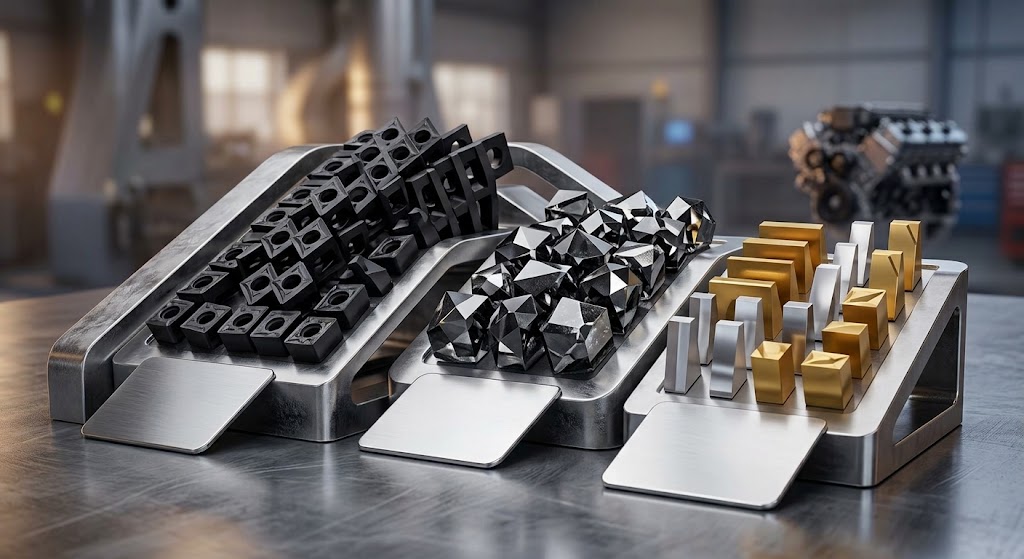
In modern high-speed manufacturing, the efficiency, precision, and cost-effectiveness of CNC metalworking depend fundamentally on the choice of cutting tool materials. As material science advances, workpiece materials—ranging from structural aluminum and cast iron to heat-resistant superalloys and hardened steels—present severe thermal, abrasive, and mechanical challenges to cutting edges.
Selecting the ideal tool substrate, geometry, and surface treatment requires a comprehensive understanding of mechanical behavior, thermal dynamics, and chemical stability at the cutting interface. Optimizing cutting tool materials allows machine shops to achieve higher metal removal rates (MRR), tighter surface finishes, and predictable tool life across diverse industrial applications.
Key Physical and Mechanical Properties of Tool Materials
Every cutting tool material operates under extreme conditions at the chip-tool interface. Temperatures can exceed $1000^\circ\text{C}$, accompanied by high local contact stresses and abrasive wear. To withstand these harsh conditions, a cutting tool material must strike a balance between three primary physical properties:
                  [ Hardness / Wear Resistance ]
                               ▲
                              / \
                             /   \
                            /     \
                           /       \
  [ Thermal Stability ] ◄───────────► [ Toughness / Impact Resistance ]
1. Hot Hardness (Red Hardness)
Hot hardness refers to a material’s capability to maintain its mechanical strength and hardness at elevated temperatures. As cutting speeds increase, friction generates substantial heat. Materials with poor hot hardness soften rapidly, leading to plastic deformation of the cutting edge and immediate tool breakdown.
2. Fracture Toughness
Toughness measures a material’s resistance to mechanical shock, impact, and crack propagation. While high hardness prevents wear, extreme hardness often comes at the expense of brittleness. High fracture toughness is essential in interrupted cuts, such as heavy milling, variable-depth turning, or machining rough castings with scale.
3. Chemical Stability and Inertness
At elevated cutting temperatures, chemical diffusion can occur between the tool and the workpiece material. Chemical stability prevents crater wear, oxidation, and adhesive wear (built-up edge formation), particularly when machining reactive metals like titanium, nickel-based alloys, or stainless steel.
Major Classes of Cutting Tool Materials
The evolution of cutting tool technology has introduced a spectrum of materials, each optimized for specific cutting conditions, material groups, and production volumes.
+-------------------------------------------------------------------------+
|                          Tool Material Spectrum                         |
+-------------------------------------------------------------------------+
|  High-Speed Steel (HSS)  -->  Solid Carbide  -->  Ceramics  -->  PCD/CBN |
+-------------------------------------------------------------------------+
|  <-- Higher Toughness                             Higher Hardness -->   |
|  <-- Lower Cutting Speeds                   Higher Cutting Speeds -->   |
+-------------------------------------------------------------------------+
1. High-Speed Steel (HSS) and Cobalt HSS
High-Speed Steel remains a versatile, low-cost option for specific machining applications. Alloyed with tungsten, molybdenum, chromium, vanadium, and cobalt (e.g., M2, M42), HSS provides high fracture toughness and resistance to chipping.
- Best Suited For: Manual machining, flexible setups, complex form tools, deep-hole drilling, and tapping where high elasticity and shock resistance are required.
- Limitations: Low hot hardness compared to advanced materials. Machining speeds ($V_c$) are generally limited to under $30\text{–}50\text{ m/min}$ in steel.
2. Tungsten Carbide (Cemented Carbide)
Cemented carbide is the dominant substrate material across modern CNC manufacturing, representing the balance point between toughness and hardness. Carbide tools consist of tungsten carbide (WC) grains embedded in a metallic cobalt (Co) binder matrix.
By adjusting the grain size (from coarse to ultra-fine micro-grain) and the cobalt percentage (typically 6% to 12%), tool engineers tailor the material performance:
- Micro-Grain Substrates: Fine grain sizes enhance hardness and edge sharpness, making them ideal for finishing operations and difficult-to-machine alloys.
- Cobalt Content: Lower cobalt content increases hardness and wear resistance; higher cobalt content increases shock resistance for interrupted cuts.
Solid carbide cutting tools, including solid carbide end mills and solid carbide drills, allow cutting speeds three to four times faster than HSS, maintaining rigidity and precision across demanding automotive, aerospace, and general engineering applications.
3. Cermets
Cermets are titanium-based composites (titanium carbide, titanium nitride) bonded with nickel or molybdenum. They sit bridge-like between conventional carbide and ceramics.
- Best Suited For: High-speed, precision finishing of ductile steels, stainless steels, and nodular cast iron where fine surface roughness and tight tolerances are critical.
- Key Properties: Low affinity for steel, resulting in superior resistance to built-up edge (BUE) and crater wear.
4. Industrial Ceramics
Ceramic tools—primarily Silicon Nitride ($\text{Si}_3\text{N}_4$) and Alumina-based ($\text{Al}_2\text{O}_3$) composites—possess exceptional hot hardness and chemical stability, allowing machining at speeds exceeding $500\text{ m/min}$.
- Alumina ($\text{Al}_2\text{O}_3$) Ceramics: Reinforced with titanium carbide (Whisker-reinforced ceramics) or zirconia, these tools excel in hard turning of hardened steels ($50\text{–}65\text{ HRC}$) and nickel-based superalloys like Inconel 718.
- Silicon Nitride ($\text{Si}_3\text{N}_4$): Offers superior thermal shock resistance, making it suitable for high-speed rough milling of grey cast iron.
5. Superabrasives: PCD and CBN
Superabrasives occupy the apex of cutting tool hardness and wear resistance.
- Polycrystalline Diamond (PCD): PCD consists of diamond particles sintered together with a metallic binder under high pressure and temperature. It is extremely hard but chemically reactive with ferrous metals at high temperatures. As a result, PCD is dedicated to machining non-ferrous materials, such as high-silicon aluminum alloys, carbon fiber reinforced polymers (CFRP), ceramics, and copper.
- Cubic Boron Nitride (CBN): Second in hardness only to diamond, CBN remains chemically inert when cutting iron-based alloys at temperatures up to $1200^\circ\text{C}$. It is widely used for hard turning of hardened bearing steels, tool steels, and high-volume machining of cast iron brake discs.
Surface Engineering: PVD and CVD Coating Technologies
Bare tool substrates often require surface engineering to enhance wear resistance and thermal isolation. Modern cutting tools utilize advanced thin-film coatings applied via Physical Vapor Deposition (PVD) or Chemical Vapor Deposition (CVD).
                                 [ Cutting Zone ]
                                        │
                         ┌──────────────┴──────────────┐
                         ▼                             ▼
                  (PVD Coatings)                (CVD Coatings)
                2–5 µm Thickness              5–15 µm Thickness
             Sharp Edges & Precision       Heavy Roughing & Turning
             TiN / TiAlN / AlCrN / TiSiNoS   TiCN / Al2O3 / TiN
PVD (Physical Vapor Deposition)
PVD coatings are deposited at relatively low temperatures ($300^\circ\text{C}\text{–}500^\circ\text{C}$), preserving the substrate’s toughness and enabling sharp cutting edges. PVD coatings typically range between $2\text{–}5\ \mu\text{m}$ in thickness.
- TiN (Titanium Nitride): General-purpose gold-colored coating offering basic wear resistance and low friction.
- TiAlN / AlTiN (Titanium Aluminum Nitride): Forms a protective aluminum oxide film at elevated temperatures, providing excellent thermal barrier protection for high-speed dry machining.
- AlCrN (Aluminum Chromium Nitride): Superior oxidation resistance and hot hardness, optimized for aggressive milling in stainless steel and superalloys.
- TiSiNoS / Nano-Multilayer Coatings: Designed for hardened steel machining up to 55 HRC or higher, offering high nanohardness ($>3500\text{ HV}$) and thermal stability up to $1100^\circ\text{C}$.
CVD (Chemical Vapor Deposition)
CVD coatings are deposited at high temperatures ($800^\circ\text{C}\text{–}1000^\circ\text{C}$), creating thicker layers ($5\text{–}15\ \mu\text{m}$). This process generates thick thermal barriers suitable for heavy-duty turning and roughing operations.
- $\text{Al}_2\text{O}_3$ (Aluminum Oxide) Layers: Provide chemical insulation and extreme crater wear resistance at high speeds.
- TiCN (Titanium Carbonitride): Offers severe abrasive wear resistance against hard inclusions in carbon steel and cast iron.
Tool Material Selection Matrix by ISO Workpiece Groups
To achieve optimal tool life and process reliability, match the tool material and coating to the ISO workpiece material classification:
| ISO Group | Workpiece Material | Primary Failure Mode | Recommended Tool Material & Coating |
| ISO P | Carbon & Alloy Steels | Flank wear, crater wear, deformation | Substrate carbide with TiCN/$\text{Al}_2\text{O}_3$ (CVD) or TiAlN (PVD); Cermets for finishing |
| ISO M | Stainless Steel (Austenitic/Duplex) | Work hardening, notch wear, BUE | Fine-grain solid carbide with sharp geometries; AlCrN or TiAlN PVD coatings |
| ISO K | Cast Iron (Grey, Nodular) | Abrasive flank wear, thermal shock | Heavy-duty carbide with AlTiN; Silicon Nitride ceramics for roughing; CBN for finishing |
| ISO N | Non-Ferrous (Aluminum, Brass, Plastics) | Built-up edge (BUE), chip adhesion | Uncoated sharp micro-grain carbide, DLC (Diamond-Like Carbon), or PCD |
| ISO S | Superalloys (Inconel, Titanium) | High heat, notch wear, work hardening | Ultra-fine grain carbide with sharp edges and internal coolant; Whisker ceramics for Inconel |
| ISO H | Hardened Steels ($>45\text{ HRC}$) | Chipping, intense thermal wear | High-hardness solid carbide with TiSiNoS/AlTiN; Whisker ceramics or CBN for hard turning |
Industrial Tooling Solutions with Solarys Carbide
When selecting high-performance tools, consistency in substrate purity, grinding tolerances, and coating adhesion is essential. Solarys Carbide (operated under Solarys Engineering Pvt Ltd) provides industrial-grade cutting tools engineered to international quality standards for precision manufacturing across India, the Middle East, and Southeast Asia.
Operating under ISO 9001 quality management standards, Solarys Carbide integrates modern CNC tool grinding automation, controlled edge preparation, and advanced PVD coating technologies into its product portfolio.
Core Product Offerings
- Solid Carbide End Mills: Featuring 2-flute, 3-flute, 4-flute, square, ball nose, and corner radius configurations. Designed for general engineering, mold and die machining, and high-feed milling across steels, stainless steels, and non-ferrous alloys.
- High Hardness Tool Series: Engineered specifically for hardened steels up to 55 HRC. Utilizing specialized TiSiNoS Pro coatings, these tools provide thermal stability and wear resistance in toolroom and production environments.
- Solid Carbide Drills: Offered in jobber ($L/D\ 8$) and stub ($L/D\ 5$) series with 0.1 mm diameter increments. Featuring self-centering point geometries and precision flute polished surfaces for chip evacuation in continuous CNC drilling cycles.
- Bespoke and Custom Tooling: Tailored cutting tool geometries manufactured according to customer technical drawings for specialized aerospace, automotive, or medical applications.
Whether optimizing standard CNC milling operations or solving complex material machining challenges, partnering with technical manufacturers like Solarys Carbide ensures access to dependable cutting tools designed for repeatability and long service life.
Best Practices for Maximizing Cutting Tool Life
Even the highest quality tool material requires proper operational control to reach its designed lifespan. Implementing machine shop best practices preserves cutting edge integrity and lowers tooling costs per part:
1. Control Total Indicated Runout (TIR)
Spindle and tool holder runout should be kept below $0.005\text{ mm}$ ($5\ \mu\text{m}$). Excessive runout distributes cutting forces unevenly across flutes, causing premature edge chipping and uneven wear. Utilize hydraulic chucks, shrink-fit holders, or high-precision ER collets.
2. Optimize Coolant Application
- High-Pressure Internal Coolant: Essential when machining deep cavities, stainless steel, or superalloys to break chips and lower interface temperatures.
- Dry Machining / MQL (Minimum Quantity Lubrication): Preferred when using high-performance PVD-coated tools or ceramics on hardened steels to prevent thermal shock and micro-cracking caused by interrupted cooling.
3. Match Tool Geometry to the Material
- Use positive rake angles and polished flutes for soft, gummy materials like aluminum and 300-series stainless steel to prevent chip welding.
- Use negative rake angles and reinforced hone edges for heavy roughing, hardened materials, and severe interrupted cuts to support the cutting edge against impact stresses.
4. Monitor Wear Patterns
Inspect tool margins regularly under magnification. Differentiating between normal flank wear, thermal cracking, notch wear, and crater wear allows operators to adjust cutting speeds, feed rates, or coolant strategy before catastrophic tool failure occurs.
Conclusion
The selection of cutting tool materials plays a critical role in modern subtractive manufacturing. From traditional High-Speed Steel to advanced solid carbide substrates, ceramics, and superabrasives, each material class offers specific performance advantages across different workpiece groups. Combining the appropriate tool material with specialized PVD or CVD coatings and rigid machining practices minimizes vibration, improves dimensional accuracy, and reduces cycle times.
By leveraging technical tooling partners such as Solarys Carbide, machine shops and manufacturing plants can implement optimized cutting solutions tailored for continuous production, achieving maximum process stability and cost efficiency across global industrial supply chains.