

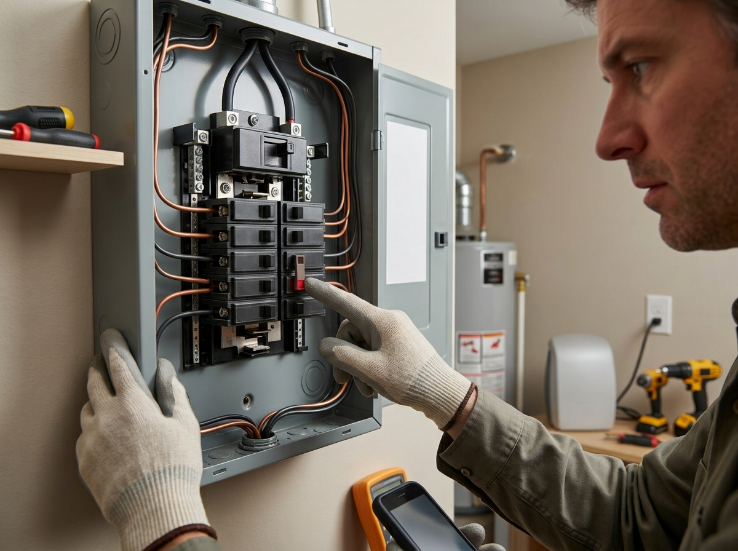
A circuit breaker that trips once may be responding to a temporary electrical event. A breaker that keeps tripping is a different matter. Repeated trips usually mean the electrical system is detecting a condition that needs attention. Continuing to reset the breaker without finding the cause can leave the actual problem unresolved.
Homeowners may notice the issue when lights go out, appliances stop running, or one part of the house suddenly loses power. The temptation is to restore the breaker and move on. That may work temporarily, but repeated failure is a signal worth investigating, particularly when the same circuit is affected again and again.
What a Circuit Breaker Actually Does
A circuit breaker helps protect an electrical circuit when the current becomes too high or another electrical condition causes the protective device to respond. When the breaker opens the circuit, it interrupts the flow of electricity rather than allowing the condition to continue unchecked.
The trip itself is therefore not necessarily the problem. It is a response to something happening within the circuit or connected equipment. The difficult part is identifying what triggered that response.
Possible causes can include an overloaded circuit, a faulty appliance, damaged wiring, a short circuit, or another electrical problem. The same symptom can come from different sources, which is why repeated resetting is not a real diagnosis.
When Replacement May Be Necessary
Circuit breaker replacement may become necessary when the breaker itself is damaged, worn, incompatible, or no longer operating correctly. However, replacing the breaker without checking the circuit can leave a deeper problem unresolved.
For example, a breaker may continue to trip because the circuit is overloaded or because a connected appliance has a fault. Installing a new breaker without correcting the underlying issue can simply produce the same symptom again.
A proper evaluation should therefore look at both the protective device and the circuit it serves. The goal is to determine why the breaker is responding and whether replacement is actually part of the correct solution.
Signs You Should Stop Resetting the Breaker
Repeated trips deserve more attention when they happen under normal household use. If the breaker trips immediately after being reset, trips whenever a specific appliance operates, or is accompanied by unusual sounds or smells, homeowners should avoid continuing to experiment.
Important warning signs include:
- Burning or unusual electrical odors
- Warmth around the electrical panel
- Buzzing or crackling
- Visible damage
- Immediate or repeated tripping
- Power loss that affects multiple connected devices
These symptoms do not identify a particular fault, but they increase the reason for professional evaluation. Electrical problems can involve components that are not safe for an untrained person to open or test.
How Overloading Can Affect a Circuit
A circuit may trip because too many electrical loads are operating at the same time. High-demand appliances can use substantial current, and several devices connected to the same circuit can push the load beyond what the circuit is designed to handle.
The important point is that the problem is not always the breaker. A breaker is doing its job when it interrupts an overloaded circuit. The long-term solution may involve redistributing loads, adding an appropriately designed circuit, or addressing another issue within the system.
Homeowners should not solve repeated trips by installing a higher-rated breaker without professional evaluation. The protective device and wiring need to be appropriately matched to the circuit.
Faulty Appliances Can Also Cause Trips
Sometimes the wiring in the home is not the original source of the problem. An appliance with an electrical fault can cause the breaker to trip when it is turned on. This can happen repeatedly and may make the problem appear to be with the breaker itself.
Homeowners may notice a pattern if the breaker only trips when one particular appliance is connected or operating. That information is useful because it gives the technician a starting point for diagnosis.
Even in this situation, the appliance should not be repeatedly tested if there are signs of damage, overheating, burning odors, or other unusual behavior. Removing the suspected appliance from service and arranging professional evaluation can be safer than continuing to reset the circuit.
Why Older Electrical Systems Need Extra Attention
Older homes may have wiring and electrical components that were designed for a different level of household demand. Modern homes often use many appliances, electronics, heating and cooling equipment, chargers, and other electrical loads simultaneously.
That does not mean every older electrical system automatically needs replacement. The condition and design of the actual system matter. However, repeated breaker trips can be a reason to examine whether the existing electrical setup still matches the property’s current use.
A professional evaluation can help identify whether the problem is isolated to one circuit or reflects a broader limitation within the electrical system.
What to Expect During a Professional Evaluation
A technician will generally need to identify the affected circuit, understand when the breaker trips, and examine the connected equipment and wiring. Testing can help determine whether the breaker, circuit, appliance, or another component is involved.
The information homeowners provide can be valuable. Tell the technician what was operating when the breaker tripped, whether the problem happens at specific times, and whether any unusual smells, sounds, or visible changes were noticed.
Good diagnosis avoids replacing parts simply because they appear to be the most obvious suspect. It focuses on the electrical behavior of the entire circuit.
Preventing Repeat Breaker Problems
Once the cause has been identified, prevention depends on the problem. If the circuit was overloaded, the electrical arrangement may need to be changed. If an appliance was responsible, that equipment may need repair or replacement. If the breaker itself failed, replacing it with a properly matched component may resolve the issue.
Homeowners can also avoid using damaged cords, overloaded temporary connections, or questionable electrical devices. Keeping the panel accessible makes inspection and service easier as well.
The most important habit is to treat repeated trips as information rather than an inconvenience. The breaker is telling you that something needs attention.
Final Thoughts
A tripping breaker should not be viewed simply as a switch that needs to be turned back on. Repeated trips can result from overloads, faulty equipment, damaged wiring, or a defective protective device, and the correct solution depends on the actual cause. Understanding overcurrent also helps explain why protective devices interrupt electrical flow when a circuit experiences more current than it is designed to safely handle.