

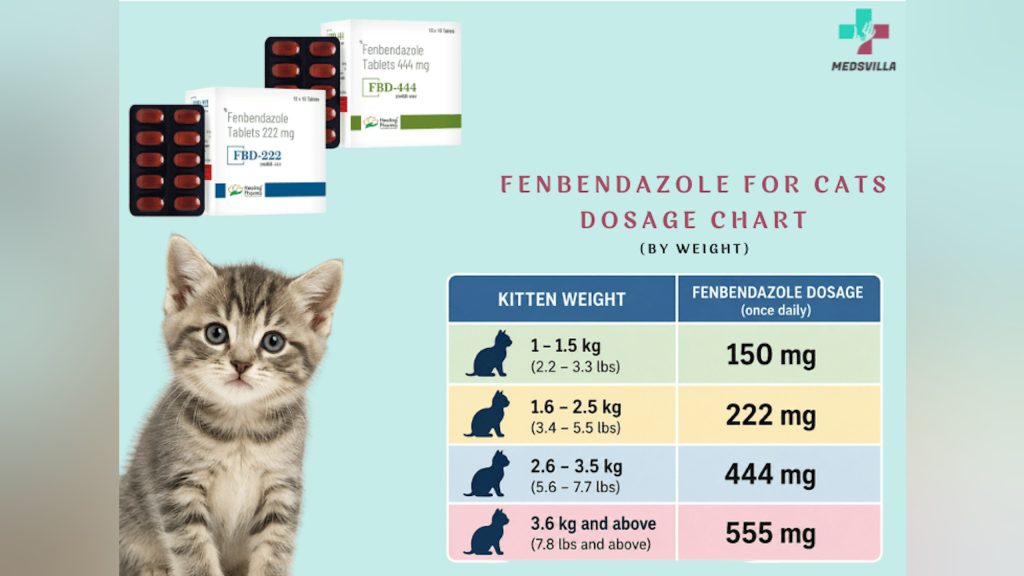
Fenbendazole is a broad-spectrum antiparasitic medicine used in veterinary medicine to treat certain intestinal and respiratory parasites. It belongs to the benzimidazole class and works by interfering with processes that parasites need to survive.
Use the fenbendazole for cats dosage chart by weight as an educational reference rather than a self-treatment guide. Confirm the appropriate product, dose, and treatment duration with a veterinarian before giving fenbendazole to your cat.
When using fenbendazole for cats, the correct dose depends on the cat’s body weight, the parasite being treated, the formulation being used, and the treatment duration. A veterinarian should confirm the diagnosis and appropriate regimen before treatment.
What Is Fenbendazole for Cats?
Fenbendazole is an anthelmintic, meaning it is used against certain parasitic worms. Veterinary references describe its use in cats for parasites including some roundworms, hookworms, tapeworms, and lungworms.
However, fenbendazole does not treat every type of parasite. For example, different medicines may be needed for fleas, some tapeworm infections, or other parasites. Your veterinarian may recommend a fecal examination or other testing before choosing a treatment.
How Does Fenbendazole Work?
Fenbendazole interferes with structures and cellular processes that parasites need to survive. Because its activity targets parasites differently from mammalian cells, benzimidazole medicines generally have a relatively wide safety margin. However, a wide safety margin does not mean that every dose or treatment duration is appropriate for every cat.
The medicine also does not protect against every parasite. A veterinarian may select another antiparasitic medicine when testing identifies a parasite that fenbendazole does not adequately target.
How Should Fenbendazole Be Given to Cats?
Follow the product instructions and your veterinarian’s directions carefully.
Depending on the formulation, fenbendazole may be administered orally and may be given with food. The exact amount should be measured accurately, especially in kittens and smaller cats where relatively small differences in dose can matter.
Before giving the medicine, check:
- Your cat’s current body weight
- The concentration or strength of the product
- The parasite being treated
- The prescribed number of treatment days
- Any other medicines your cat is receiving
Avoid estimating a dose from a product intended for another species. FDA information notes that fenbendazole products may be used in cats either as labeled or in an extralabel manner when appropriate, and a veterinarian may select a different dosage form or strength when needed.
Fenbendazole Safety Tips for Cats
Fenbendazole is generally considered to have a relatively wide safety margin among anthelmintic medicines, but adverse effects can still occur.
Watch your cat for unusual symptoms after treatment, including:
- Vomiting
- Diarrhea
- Reduced appetite
- Unusual tiredness
- Changes in behavior
- Other unexpected symptoms
Contact a veterinarian if symptoms are severe, persistent, or concerning.
Extra caution is appropriate for kittens, pregnant cats, nursing cats, elderly cats, or cats with other health problems. Your veterinarian can determine whether fenbendazole is suitable and whether additional testing or treatment is necessary.
Be Careful With Online Product Searches
People may also search for fenbendazole and ivermectin tablets price when comparing antiparasitic products online. Price alone should not determine which medicine is used for a cat.
Check the active ingredients, concentration, intended animal species, dosing instructions, manufacturer, and regulatory status. A product intended for humans or another animal species may have a different formulation or dosing requirement.
Similarly, the phrase ivermectin and fenbendazole pills for humans refers to products intended or discussed for human use and should not be used as a shortcut for treating a cat. Human medicines can differ substantially in formulation, concentration, and approved indications.
When Should You Contact a Veterinarian?
Professional advice is particularly important when:
- Your cat has persistent vomiting or diarrhea.
- You see worms or unusual material in the stool.
- Your cat is losing weight.
- A kitten has a suspected parasite infection.
- Your cat is pregnant or nursing.
- Your cat takes other medications.
- The infection has returned after treatment.
- You are unsure which parasite is present.
A fecal examination can help identify the parasite and guide treatment. Some parasite infections require a different medicine or a longer treatment course.
What About Fenbendazole and Ivermectin Together?
Searches for fenbendazole ivermectin pills and fenbendazole ivermectin capsules can return products marketed as combinations or discussions about using the two medicines together. That does not mean they should automatically be combined for a cat.
Fenbendazole and ivermectin are different antiparasitic medicines, and their appropriate use depends on the parasite and the animal. Veterinary references describe some situations where fenbendazole and ivermectin have both been reported for particular infections, but this does not establish that the combination is appropriate for routine deworming.
Never combine antiparasitic medicines simply because both are described as dewormers. Ask your veterinarian whether combination treatment is actually indicated.
Final Thoughts
Fenbendazole can be an effective veterinary antiparasitic for certain infections in cats, but there is no single dose that applies to every situation. A commonly referenced regimen is 50 mg/kg orally once daily for 3–5 days for certain feline parasite infections, but the correct treatment depends on the diagnosis and product.