

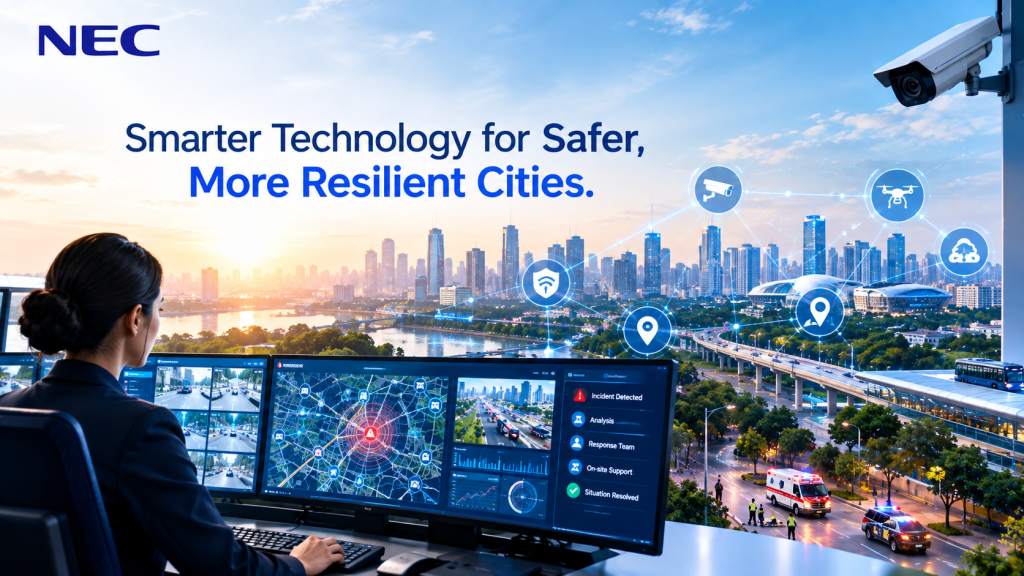
Urban environments are becoming increasingly complex. Population growth, connected infrastructure, transportation networks, public services and digital systems now operate as an interconnected ecosystem. When an incident occurs, the challenge is no longer simply to identify what happened—it is to understand the situation quickly, coordinate the right resources and make decisions that protect citizens and maintain essential services.
The evolution of incident response is therefore closely linked to the evolution of the city itself. The central idea explored in CXOToday’s discussion is that modern response systems need to align technological innovation with broader public objectives, rather than treating technology as an isolated layer.
For NEC Corporation India, this approach connects directly with its work across smart cities, public safety, artificial intelligence, intelligent video analytics and Integrated Command and Control Centres (ICCCs). NEC’s smart-city architecture brings together real-time data, analytics and decision-support capabilities to improve situational awareness and coordinate responses across urban operations.
From Reactive Response to Real-Time Intelligence
Traditional incident management often begins after an event has already occurred. A complaint is received, an emergency call is made or an operational failure becomes visible. Teams then assess the situation and decide how to respond.
Modern systems can shift this model toward continuous awareness.
Sensors, cameras, connected devices and digital platforms can generate information from multiple parts of a city. AI and analytics can then help identify patterns, highlight anomalies and provide decision-makers with a clearer picture of what is happening.
NEC’s smart-city solutions describe the ICCC as a central platform for real-time monitoring, data integration and decision support. Its architecture also incorporates AI, intelligent video analytics, citizen engagement and IoT capabilities.
The value lies not simply in collecting more data, but in turning fragmented information into actionable intelligence.
Why Integration Matters During an Incident
An urban incident rarely belongs to a single department.
A major traffic disruption can affect emergency services. A public-safety incident can influence transportation. Severe weather can impact electricity, water, mobility and communications simultaneously.
This makes coordination critical.
NEC’s smart transportation framework includes integrated command and control, emergency response, security and surveillance, AI, enhanced video analytics and smart-city infrastructure within a connected ecosystem.
Such integration can help authorities move from isolated departmental responses toward coordinated decision-making.
The objective is not to automate every decision. It is to ensure that the people responsible for critical decisions have timely, relevant information when they need it.
AI’s Role: Detection, Analysis and Decision Support
Artificial intelligence can add another layer to incident response by helping systems process large volumes of information faster than conventional manual approaches.
NEC has previously described its AI approach through three broad functions: visualisation, analysis and prescription—understanding real-world situations, analysing information to identify patterns or forecast outcomes, and supporting planning or optimisation.
Applied to public infrastructure, these capabilities can support areas such as crowd behaviour analysis, public safety, infrastructure monitoring and predictive operations.
The distinction is important. AI should not simply generate alerts. Its greater value comes from helping authorities understand which information matters, what it may indicate and what response options should be considered.
The Human Element Cannot Be Removed
Technology can accelerate detection and improve situational awareness, but incident response remains fundamentally a human responsibility.
Emergency decisions involve context, accountability and consequences. Authorities need to consider citizens, vulnerable communities, infrastructure, resources and the wider public interest.
That is why modern incident-response architecture needs to keep people at the centre.
AI can process information and identify patterns. Human teams provide judgement, context and accountability. The strongest systems therefore combine automation with clearly defined operational procedures and human oversight.
Building Resilience, Not Just Response
The real measure of an incident-response system is not only how quickly it reacts to an emergency. It is also how effectively the city learns from disruption.
Every incident can generate information about infrastructure weaknesses, response gaps, resource requirements and citizen needs.
A connected platform can help organisations use this information to improve future planning and operational readiness.
This turns incident management into a continuous cycle: observe, understand, respond, learn and improve.
For technology providers such as NEC Corporation India, this broader perspective is particularly relevant because its portfolio extends beyond emergency response into transportation, digital identity, public safety, AI and smart-city infrastructure.
A Practical Example: Smarter Passenger Response
The same principle can be seen outside conventional emergency management.
NEC’s Digital ID solution, deployed with the Airports Authority of India under DigiYatra, uses biometric identification to support airport entry, check-in, security and boarding. The system is designed to make passenger movement more efficient while maintaining security and providing an alternative traditional process for passengers who do not wish or are unable to use biometrics.
This illustrates an important principle of modern infrastructure: the best technology often works quietly in the background while improving the experience people actually notice.
The Next Phase of Incident Response
As cities become more connected, incident response will increasingly depend on interoperability, real-time intelligence and the ability to translate data into coordinated action.
But technology alone will not create resilient cities.
The next generation of public-response systems will need to connect people, processes, data and technology around clearly defined public objectives.
That is where the evolution becomes meaningful. Incident response is no longer simply about reacting faster after something goes wrong. It is about creating the intelligence, coordination and resilience required to help cities prepare better, respond smarter and recover stronger.
For organisations such as NEC Corporation India, the opportunity is to make advanced technologies part of this larger civic ecosystem—where innovation is ultimately measured not by the sophistication of the system, but by the value it creates for citizens and the institutions serving them.