

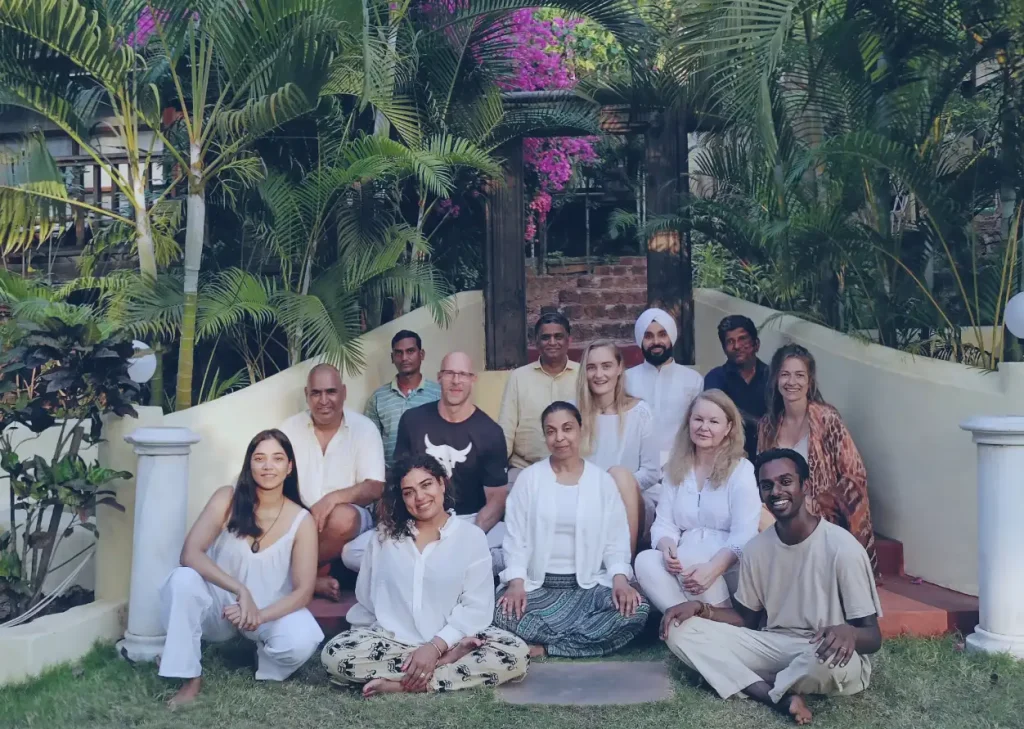
Yoga practice can take many forms. Some sessions are energetic and movement-focused, while others emphasize stillness, longer-held postures, breathing, and meditation. Yin Yoga is often associated with the quieter end of this spectrum, while more active practices may involve repeated movement, muscular engagement, and stronger physical demands.
These approaches are sometimes presented as opposites. However, they can also be understood as complementary parts of a broader movement and mindfulness practice.
The nervous system is constantly responding to movement, sensory information, breathing, posture, attention, and the environment. A balanced yoga practice can provide opportunities to experience both physical activation and periods of relative stillness.
Understanding the Nervous System in Simple Terms
The nervous system coordinates communication throughout the body and plays an important role in movement, sensation, attention, and responses to the environment.
The autonomic nervous system is particularly relevant when discussing relaxation and activation. It includes the sympathetic and parasympathetic branches, which are commonly associated with different patterns of physiological regulation.
The sympathetic branch is involved in mobilizing the body for action, while the parasympathetic branch is involved in functions associated with rest and recovery.
However, the nervous system does not simply operate like an on-and-off switch between “stress” and “relaxation.” Human physiology is considerably more complex.
Yoga practices can influence how a person experiences arousal, attention, breathing, and relaxation, but individual responses can vary considerably.
This is one reason why it is more useful to view yoga as a practice that provides different inputs rather than as a guaranteed method for producing a particular nervous-system state.
What Active Yoga Practice Offers
Active yoga practices may involve flowing sequences, standing postures, transitions, balance work, and muscular engagement.
These activities require the body to coordinate movement while responding to changing physical demands.
An active practice may also increase breathing rate, body temperature, muscular activity, and attention to movement.
For many practitioners, this type of practice can feel energizing. It can provide an opportunity to develop strength, coordination, balance, and physical confidence.
Active movement also gives the mind something specific to attend to. Moving from one posture to another requires awareness of position, timing, breathing, and balance.
This combination can make active yoga a valuable part of a broader practice.
What Yin Yoga Offers
Yin Yoga takes a different approach.
Postures are commonly held for longer periods, with an emphasis on relative stillness and reduced muscular effort. Practitioners may use props to support the body while paying attention to sensations and mental activity.
This slower pace creates a different environment for practice.
Instead of continuously responding to movement, practitioners have more time to observe what happens when they remain relatively still.
They may notice changes in physical sensation, breathing, thoughts, emotional responses, or the urge to move.
The practice can therefore become an opportunity for observation and patience rather than simply physical exercise.
Importantly, this does not mean every Yin Yoga session automatically produces a particular physiological response. The experience depends on the person, the environment, the posture, the duration, and many other factors.
Why Alternating Between Activity and Stillness Can Be Valuable
The human body is designed to respond to changing demands.
We move, rest, concentrate, recover, and respond to our surroundings throughout the day.
A yoga practice that includes both active movement and quieter periods can reflect this broader pattern.
An active sequence may help practitioners develop physical engagement and awareness of movement. A quieter practice may provide time to observe sensations and thoughts without continuously changing position.
The two experiences can also make each other more noticeable.
After an active practice, stillness may feel particularly different. Similarly, after a quiet Yin practice, moving into a more dynamic sequence may bring greater awareness to muscular effort and body position.
The value is not necessarily in deciding that one approach is better than the other, but in understanding what each practice offers.
The Traditional Yin and Yang Framework
Yin and Yang are concepts from Chinese philosophical traditions that describe complementary qualities rather than two completely separate categories.
In modern yoga communities, these ideas are sometimes used to describe slower, quieter practices as “Yin” and more dynamic practices as “Yang.”
This can be a useful framework for discussing differences in practice style, but it should not automatically be treated as a scientific classification of the nervous system.
Traditional philosophy and modern physiology are different knowledge systems.
A responsible yoga education can explore both while making the distinction clear.
This allows students to appreciate the philosophical foundations of Yin practice without presenting traditional concepts as if they were direct scientific measurements.
Breathing and Attention Matter Too
The physical intensity of a yoga practice is only one part of the experience.
Breathing and attention can also influence how a practitioner experiences a session.
During an active practice, attention may be directed toward coordinating breath with movement. During a quieter Yin practice, attention may remain with the breath, physical sensation, or thoughts for longer periods.
This sustained attention can develop observational skills.
However, there is no single breathing pattern or meditation experience that will feel identical for everyone.
Teachers should therefore provide options rather than promising that a specific technique will always create relaxation or a particular physiological outcome.
Learning to Recognize Your Own Response
One of the most useful skills in yoga is learning to observe personal responses.
A practitioner might notice that a particular active sequence leaves them feeling energized, while another person may find the same sequence demanding.
Likewise, one person may experience a long Yin hold as calming, while another may find prolonged stillness mentally challenging.
Neither response necessarily means that the practice is working or failing.
Individual differences matter.
Factors such as sleep, physical condition, previous experience, environment, expectations, and current circumstances can influence how a person responds to practice.
Developing self-awareness can therefore be more useful than trying to force a predetermined response.
Why Teachers Need a Broader Understanding
Yoga teachers work with people who have different physical abilities, movement histories, preferences, and responses to practice.
Understanding the difference between active and passive practices can help teachers design more balanced classes.
A teacher may choose an active sequence to build movement and physical engagement, followed by quieter practices that allow students to transition toward stillness.
Alternatively, a session may intentionally focus on Yin postures and meditation.
The important consideration is understanding the purpose of the practice and communicating it responsibly.
Teacher training can provide an opportunity to study these concepts alongside anatomy, sequencing, meditation, philosophy, and teaching methodology. A structured in yin yoga teacher training program can help practitioners explore both the physical and contemplative dimensions of Yin practice while developing skills for guiding others.
Creating Balance Without Chasing a Particular State
The goal of combining Yin and active practice does not need to be achieving a specific nervous-system state.
Instead, the value can come from experiencing different forms of movement, effort, stillness, attention, and recovery.
An active practice can challenge the body to move and coordinate. A Yin practice can invite relative stillness and observation. Meditation can provide another opportunity to develop sustained attention.
Together, these practices can create a broader approach to yoga.
Rather than asking whether Yin or active practice is better, a more useful question may be:
What does my practice need today, and how can I approach it with awareness?
That question keeps the focus on individual experience rather than rigid rules.
Conclusion
Yin Yoga and active yoga offer different practice experiences, but they do not have to exist separately.
Active movement can develop strength, coordination, balance, and physical engagement. Yin practice can create space for stillness, sustained attention, and exploration of sensation. Both can contribute to a broader understanding of the body and mind.
The nervous system is complex, and yoga should not be presented as a guaranteed switch between stress and relaxation. Instead, practitioners can use different practices to explore how movement, stillness, breathing, attention, and environment influence their experience.
For teachers, understanding these distinctions can support more thoughtful class design and more responsible communication. With appropriate education and practice, Yin and active approaches can become complementary parts of a well-rounded yoga journey.