

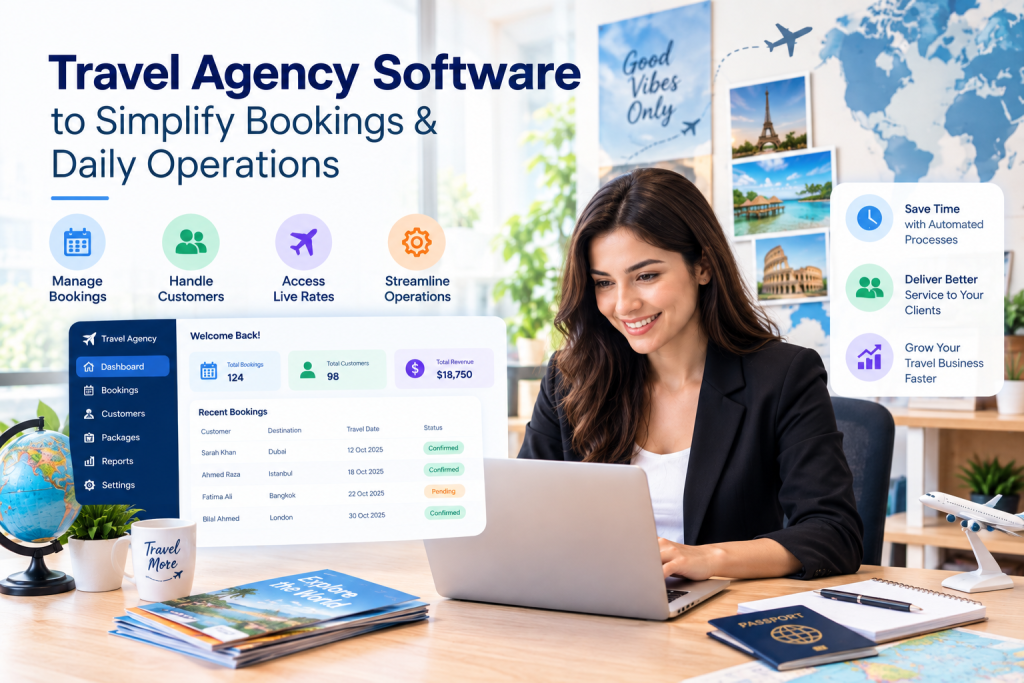
Running a travel business involves much more than selling holidays. Agencies and tour operators often have to manage customer inquiries, supplier information, bookings, payments, itineraries, commissions, documents, and follow-ups at the same time. When these activities are handled through disconnected spreadsheets, emails, messaging apps, and separate systems, even routine tasks can become difficult to manage.
Modern Travel Software Solutions bring many of these processes into a more organized environment. Instead of switching between multiple tools, travel businesses can use software to centralize operational information, automate repetitive work, and give teams better visibility into bookings and customers.
The right solution is not simply about adding more technology. It should solve specific operational problems and make everyday work easier for both staff and customers.
What Travel Businesses Need From Modern Software
Travel businesses operate differently from standard retail or service companies. A single booking can involve a traveler, agent, airline or hotel supplier, payment, documentation, and several follow-up activities.
For that reason, travel software needs to connect different parts of the business rather than focusing on only one function.
A useful platform may bring together booking management, customer relationship management, supplier coordination, payment tracking, reporting, and itinerary management. The exact combination depends on whether the business is a travel agency, tour operator, corporate travel company, DMC, or B2B travel provider.
For businesses evaluating different platforms, it is helpful to first identify where time is being lost. If employees spend hours manually updating booking records or searching through conversations for customer information, those areas should become a priority during software selection.
Businesses exploring Travel Software Solutions can also use a product demonstration to understand how a platform would fit their existing workflow rather than judging software only by its feature list.
Centralize Bookings and Customer Information
One of the biggest operational challenges for travel companies is keeping information organized.
Customer details may exist in an email inbox, booking information in a spreadsheet, payment records in accounting software, and itinerary details in another document. This fragmentation makes it harder to understand the complete status of a customer or reservation.
A centralized travel management system can bring important information together.
For example, when an agent opens a customer record, they may be able to see contact information, previous interactions, current bookings, payment status, and related travel arrangements from one place.
This can reduce unnecessary searching and make handovers between employees easier. If one employee is unavailable, another team member can understand the booking without relying entirely on personal notes or memory.
Keep the Booking Journey Organized
A booking normally moves through several stages, from inquiry to confirmation and sometimes changes or cancellation. Software can help teams track these stages consistently.
Instead of asking whether a booking has been confirmed, paid, or followed up, employees can check its current status directly in the system.
This becomes particularly useful as booking volume increases.
Improve B2B Travel Operations
B2B travel businesses have additional requirements because they may work with travel agents, resellers, corporate clients, wholesalers, and suppliers.
A B2B travel platform can provide tools for managing partner relationships, distributing inventory, handling bookings, and maintaining different business workflows.
For example, a wholesaler may provide hotels or other travel services to multiple agencies. Managing every partner manually can become complicated when each account has different requirements, pricing structures, or booking activity.
A centralized platform can make these relationships easier to monitor while reducing repetitive administrative work.
Businesses considering a b2b travel portal demo can examine how the portal handles partner access, booking workflows, inventory, and other B2B requirements before making a decision.
Automate Repetitive Administrative Tasks
Automation is one of the most practical reasons to introduce travel technology.
Travel employees frequently perform repetitive activities such as sending booking confirmations, updating records, creating documents, following up with customers, or checking payment statuses. These tasks may appear small individually, but they consume significant staff attention when repeated throughout the day.
Travel software can automate selected workflows so employees can spend more time on activities that require human interaction.
For example, when a booking reaches a particular stage, the system may trigger a confirmation or update the relevant record automatically. A CRM can also help teams schedule follow-ups instead of relying on manual reminders.
Automation should not remove human involvement from the travel experience. Customers often need advice, reassurance, destination knowledge, or assistance when plans change. The purpose is to reduce unnecessary administrative work around those interactions.
Make Customer Management More Consistent
Customer experience depends partly on how well a business manages information.
If an agent cannot quickly find a customer’s previous booking or request, the customer may have to explain the same information again. A centralized CRM can help prevent this by maintaining a structured customer history.
Travel CRM functionality can be particularly useful for agencies handling leads before they become confirmed customers.
A prospective traveler might initially request a quote, ask about different destinations, change their dates, and then return several days later. A CRM allows the business to track these interactions and continue the conversation with better context.
Manage Leads Beyond the First Inquiry
Not every inquiry becomes a booking immediately.
A good system can help teams distinguish between new leads, active prospects, confirmed customers, and previous customers. This gives employees a clearer way to prioritize follow-ups.
It also provides management with a better view of the sales pipeline without requiring employees to create separate reports manually.
Simplify Itinerary and Travel Document Management
Itinerary creation is another area where travel businesses can benefit from dedicated software.
An itinerary may contain flights, hotels, transfers, activities, schedules, traveler information, and other details. Creating and updating these documents manually can be time-consuming, particularly when an itinerary changes several times.
An itinerary builder can organize these details into a structured travel plan.
The benefit is not limited to presentation. Keeping itinerary information connected to the booking can reduce the risk of outdated details being sent to customers.
Travel document management can also help teams organize important files associated with reservations. Depending on the platform, this may include invoices, confirmations, vouchers, or other booking-related documents.
Connect Travel Services Through APIs
Travel companies often need access to external services such as hotels, flights, transfers, activities, or destination products. Application programming interfaces, commonly called APIs, allow different systems to exchange information.
For example, a hotel API can allow a booking platform to retrieve hotel availability and pricing from an external provider. A flight API can provide access to airline-related inventory and booking functions, depending on the provider and integration.
API integration can therefore reduce the need to manually enter information from multiple suppliers.
However, integration quality matters. Businesses should examine how data is synchronized, how errors are handled, how availability is updated, and what technical support is available.
A travel business should also consider whether it needs one supplier connection or multiple sources. The right approach depends on its products, markets, customers, and operational model.
Improve Payment and Financial Tracking
Payment management can become complicated when a business handles deposits, balances, refunds, commissions, supplier payments, and multiple bookings.
Travel software can help teams maintain clearer records of payment status and outstanding amounts.
For example, an employee should be able to identify whether a reservation has been fully paid, whether a balance remains, or whether a refund requires attention.
Financial functionality does not necessarily replace dedicated accounting software. Instead, it can provide operational visibility that helps booking and finance teams work from consistent information.
This is especially useful when sales teams need to know whether a reservation is financially complete before taking the next step.
Give Managers Better Operational Visibility
As a travel business grows, owners and managers need more than individual booking records. They need an overview of how the business is performing operationally.
Reporting tools can help organize information about bookings, sales activity, customers, suppliers, and other business processes.
Instead of manually combining information from multiple spreadsheets, managers can use dashboards or reports available within the platform.
The important consideration is whether the reports answer practical business questions.
For example:
- Which bookings still require action?
- Which payments are outstanding?
- How many inquiries are currently active?
- Which agents are handling the most bookings?
- Which services are generating business activity?
The value of reporting comes from turning operational data into information that employees can actually use.
Choosing Software That Fits Your Business
There is no single software configuration that works for every travel company.
A small travel agency may prioritize CRM, booking management, customer communication, and invoicing. A tour operator may need stronger itinerary and supplier-management functionality. A B2B company may place greater emphasis on partner portals, inventory distribution, and API connectivity.
Before selecting a platform, businesses should map their current workflow.
Start by documenting how a customer moves from the first inquiry to completed travel. Then identify the steps that are manual, duplicated, difficult to track, or dependent on individual employees.
After that, compare software based on those actual requirements.
Important considerations include:
Ease of use: Employees should be able to learn the system without unnecessary complexity.
Scalability: The platform should support the business as booking volume and team size change.
Integration: Check whether it can connect with the travel suppliers and other systems the business already uses.
Security and access: Understand how customer and booking information is protected and how user permissions work.
Support: Reliable technical and product support can be important when the platform becomes part of daily operations.
Customization: Different travel businesses often need different workflows, fields, documents, or integrations.
How Travel Technology Can Support Business Growth
Software cannot replace good service, destination knowledge, supplier relationships, or effective sales. What it can do is provide the operational foundation that allows a team to manage those activities more efficiently.
When information is centralized, employees spend less time searching for records. When repetitive processes are automated, staff can focus on customer conversations. When reporting is clearer, managers can identify operational issues sooner.
This is where Synch Travel can be relevant for travel businesses looking for a technology platform that brings different travel-management requirements into a more connected workflow.
The most useful approach is to treat software as part of the business process rather than as a standalone purchase. A platform should support the way the company actually sells, books, manages, and services travel.
Final Thoughts
The right travel technology can simplify many of the processes that make travel operations difficult to manage manually. Booking management, CRM, B2B operations, automation, itinerary creation, API connectivity, payments, and reporting can all become more structured when they are handled through an appropriate system.
The key is to choose based on real operational needs rather than selecting a platform simply because it has a long list of features.
Before investing, map your existing workflow, identify the biggest sources of manual work, and determine which processes need better visibility or automation. A suitable solution should make everyday tasks clearer for employees while helping the business provide a more consistent experience to travelers and partners.